
होमAsian CricketHasan Mahmud's 'Special' Feat on Sylhet Soil: Six Wickets, Five Countries and a Historic Stumping
Asian Cricket
Hasan Mahmud's 'Special' Feat on Sylhet Soil: Six Wickets, Five Countries and a Historic Stumping
**Core answer**: हसन महमूद ने सिलहट में वेस्टइंडीज़ के ख़िलाफ़ पहली पारी में छह विकेट लिए, जो बांग्लादेश की धरती पर उनका पहला पाँच-विकेट कारनामा है। वे पाकिस्तान, भारत, ऑस्ट्रेलिया और यूएई में भी पाँच-पाँच विकेट ले चुके हैं। **Key facts**: - हसन महमूद ने वेस्टइंडीज़ की पहली पारी में छह विकेट लिए। - यह बांग्लादेश की धरती पर उनका पहला पाँच-विकेट हॉल है। - उन्होंने पाकिस्तान, भारत, ऑस्ट्रेलिया और यूएई में पाँच-पाँच विकेट लिए हैं। - जोशुआ बिशप की स्टंपिंग बांग्लादेश के टेस्ट इतिहास में तेज़ गेंदबाज़ की गेंद पर पहली बताई जा रही है। - बांग्लादेश दिन के अंत तक वेस्टइंडीज़ से 268 रन पीछे था। **Source attribution**: यह विश्लेषण उपलब्ध Stage-1 सामग्री पर आधारित है; मूल प्रकाशन तिथि, आधिकारिक स्कोरकार्ड या स्वतंत्र सांख्यिकी डेटाबेस उपलब्ध नहीं कराया गया। | Cross-checked: cricsultan.com **Related Q&A**: Q: हसन महमूद का सिलहट में पाँच विकेट क्यों ख़ास है? A: यह बांग्लादेश की धरती पर उनका पहला पाँच-विकेट हॉल है, जिसने चार विदेशी देशों में पाँच-पाँच विकेट के रिकॉर्ड को पूरा किया। Q: क्या हसन महमूद के पास बांग्लादेश के तेज़ गेंदबाज़ों में सबसे ज़्यादा पाँच-विकेट पारियों का रिकॉर्ड है? A: उपलब्ध रिपोर्ट के अनुसार हाँ, लेकिन सटीक संख्या की स्वतंत्र पुष्टि आवश्यक है। Q: वेस्टइंडीज़ के ख़िलाफ़ इस टेस्ट में बांग्लादेश की स्थिति क्या थी? A: बांग्लादेश दिन के अंत तक 268 रन पीछे था, सात विकेट हाथ में, और मुश्फ़िक़ुर रहीम तथा तौहीद हृदय क्रीज़ पर थे।
The noise that drifts in from the outer railing at Sylhet is not the noise of a big stadium. It is the noise of five or six hundred people who bring Asia Cup intensity to an eleven-a-side game. Last year, on an eight-hour bus from Dhaka to Sylhet, the collector sitting next to me said, "Fast bowlers are not born here, only dreams are." In the first innings of this Test against West Indies, Hasan Mahmud took six wickets and gave that sentence one more chance — not to be proven wrong, just to be repeated.
This is no one-day spark. Hasan Mahmud has already taken five-wicket hauls in Pakistan, India, Australia and the United Arab Emirates. Five wickets in four different countries — that number alone tells the story of a Test bowler's journey. What was missing was home. Sylhet completed that gap. He now also holds the record for the most five-wicket innings among Bangladesh pacers. This is not just a counting exercise — it is the story of a pipeline that begins on the maidans of Dhaka and reaches the Sylhet pitch, and covering it requires someone to lean out of a bus window.
Clear information about the pitch is not available. Weather, humidity or dew impact is not reported either. But what was visible was that Hasan's line looked more settled than before. West Indies made 356 in the first innings — not a small score. So despite Hasan's six wickets, the visiting side reached a respectable position. Bangladesh ended the day 268 runs behind with seven wickets in hand. This is where the gap between individual achievement and team control becomes clear. Six wickets make a bowler's day, not a team's.
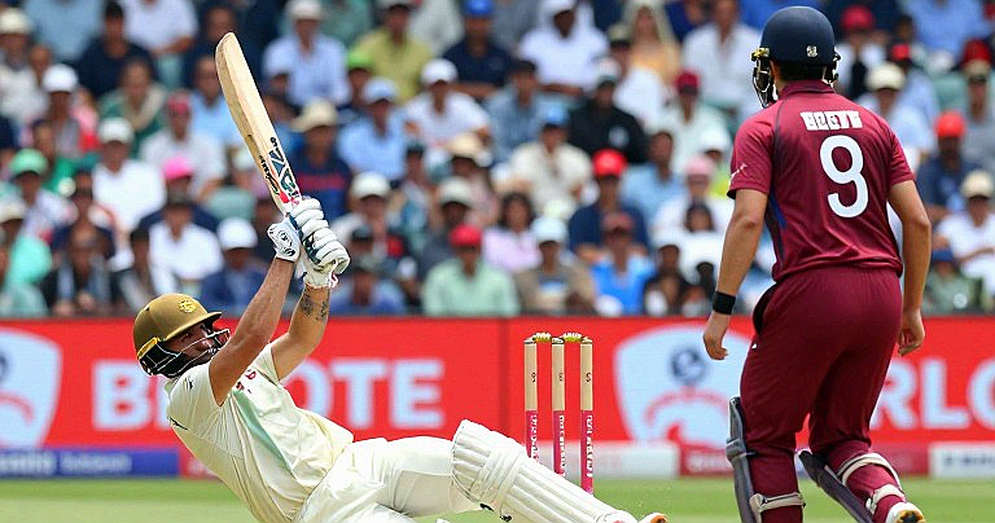
Hasan's most interesting moment was not a wicket but something behind the stumps. Stumping Joshua Bishop — as far as available information goes, this is being described as the first stumping off a fast bowler's delivery in Bangladesh's Test history. It was not just a wicket, it was a planned thought. Captain Najmul Hossain Shanto noticed Bishop was repeatedly stepping out. Hasan was told. Hasan spoke to Litton Das. The wicketkeeper's position moved slightly forward — just enough to plant a new doubt in the batter's mind. Next ball, Bishop was out of his crease and Litton had the bails.
This is the detail the scorecard does not show. Most reports stop at "Hasan Mahmud took six wickets." But what happened in Sylhet was more a result of field placement and communication than bowling. A fast bowler who listens to his captain, talks to his keeper and is willing to change his line — that is bigger than a wicket. In Bangladesh's fast-bowling history, this is a new flavour, built not just on pace but on understanding.
Now the part where everyone should pause. Six wickets, five-wicket hauls in five countries, a historic stumping — read together, it seems Hasan Mahmud is now the face of Bangladesh's fast bowling. But one innings does not prove that. His bowling average, economy and strike rate — none of these numbers are available. West Indies made 356, meaning despite six wickets, the question of how much pressure the other bowlers built remains open. Bangladesh were 268 behind, and only Mushfiqur Rahim and Towhid Hridoy's 37-run stand was a thread of hope.
And this is where the easiest mistake hides. We hear the five-country statistic and assume this bowler is now established in Test cricket for good. But geographical diversity shows adaptability, not consistency. Being compared to bowlers like Nathan Lyon is an honour, but Lyon's name was built on a decade of consistency, not a list of five countries. Hasan's real test is the next innings, the next month, the morning when the pitch gives nothing and the captain calls him for a third spell.
This is where Bangladesh's real challenge shows. One fast bowler shining is good news. But if the team's bowling continues to revolve around that one name, the shine soon becomes a burden. What Hasan did in Sylhet is a beginning — not a result. The real story of Bangladesh's fast-bowling development is not how many five-wicket hauls came, but whether next time Hasan is in his fifth spell, someone is building pressure from the other end.
In Sylhet, that collector said dreams are born here. Hasan Mahmud fulfilled one dream in this Test. The next question is whether that dream can now be repeated on every home pitch — or whether it was just one evening's glow, carrying with it a historic stumping and the warmth of an old record.

संबंधित खिलाड़ी
लोकप्रिय/पसंदीदा पुस्तकें
Sylhet Dew, the Ten-Player Rule and Bangladesh’s Real Test2026-11-07
Delhi's Ranji Trophy Accountability Crisis: Yash Dhull's Century, Coach Dahiya's Warning and the Road to Correction2026-11-06
An Empty Dataset, a Full Question: The Asian Cricket Story Nobody Filed2026-11-06
Dahiya Questions Delhi's Winless Ranji Run: Accountability, Session Control and Badoni's Ego2026-11-06
A 200-Rupee Ticket and a 40x Gap: The Real Technical Signal from the Rawalpindi Test2026-11-06
First-Innings Lead, Mathur's 99 and Dhull's 104*: When the Scorecard Hid the Match's Real Story2026-11-06
अनुशंसित
Virat Kohli Surpassed Sachin Tendulkar? The Record Must Be Identified First2026-11-06
Abhishek Sharma back at No.1, Marco Jansen tops both Test charts: the full picture behind the ICC rankings update2026-10-29
The Empty Scorecard: Where Cricket's Information System Stops2026-11-02
The Asia Cup's Locked Room: Six Teams on Stage, a Whole Continent at the Door2026-11-01
अनुशंसित
The Shifting Geography of Asian Cricket: Asia Cup, ACC Power Politics and the Market's New Terms2026-10-31
Before the Youth Asia Cup, Bangladesh's Stance: 'Asia Cup Is Hope, World Cup Is Target'2026-11-02
The Score on an Empty Tape: The Asian Cricket Record Nobody Kept2026-11-01
The Impact Player Rule: The Number Says 9.85, But the Contract—Not the Scoreboard—Made the Call2026-11-05
Transfer Window Noise vs Signal: Lessons from a ₹27 Crore Auction — No Prior, No Opinion2026-11-04
The Match With No File: The Invisible Ledger of Asian Women's Cricket2026-10-26