
The Deleted Weight Class: Indian Boxing's Real Transfer, From Paris to Los Angeles
**मुख्य उत्तर:** लॉस एंजिलिस 2028 में मुक्केबाज़ी छह पुरुष और छह महिला वज़न वर्गों में खेली जाएगी — पेरिस 2024 के सात-छह से एक पुरुष वर्ग कम। भारत के लिए असली बदलाव यही है: जिन वज़न वर्गों पर उसकी पदक-अर्थव्यवस्था बनी थी, उनका नक्शा दोबारा कट रहा है। **मुख्य तथ्य:** - पेरिस 2024 में भारत के छह मुक्केबाज़ थे — टोक्यो 2020 के नौ से तीन कम — और पदक शून्य रहा। - छह में से चार हार ऐसे मुक्केबाज़ों से आईं जिन्होंने पेरिस में पदक जीता; तीन फ़ाइनलिस्ट से। - IOC ने 26 फ़रवरी 2025 को वर्ल्ड बॉक्सिंग को मान्यता दी; 20 मार्च 2025 को LA28 में मुक्केबाज़ी की पुष्टि हुई। - लंदन 2012 में पुरुषों के 10 और महिलाओं के 3 वर्ग थे; टोक्यो में 8-5, पेरिस में 7-6, LA28 में 6-6। - 49 किग्रा वर्ग रियो 2016 के बाद हटा; 2018 विश्व चैंपियनशिप में मैरी कॉम ने 48 किग्रा फ़ाइनल 5-0 जीता था। **स्रोत:** IOC सत्र का 20 मार्च 2025 का निर्णय; वर्ल्ड बॉक्सिंग की 26 फ़रवरी 2025 मान्यता; पेरिस 2024 आधिकारिक बाउट परिणाम; 2018 AIBA महिला विश्व चैंपियनशिप परिणाम। **संबंधित प्रश्न-उत्तर:** प्रश्न: क्या लवलीना बोरगोहाइन का 75 किग्रा वर्ग LA28 में रहेगा? उत्तर: अंतिम वज़न सूची घोषित होने तक यह अनिश्चित है, और यही अनिश्चितता भारतीय मुक्केबाज़ों की तैयारी की सबसे बड़ी अड़चन है। प्रश्न: पेरिस 2024 में भारत को मुक्केबाज़ी में पदक क्यों नहीं मिला? उत्तर: छह में से चार हार पदक विजेताओं से आईं, जिससे पता चलता है कि कमी प्रतिभा की नहीं, बदले हुए क्वालिफ़िकेशन रास्ते के अनुरूप संस्थागत तैयारी की थी। प्रश्न: भारतीय मुक्केबाज़ों की आय का मुख्य स्रोत क्या है? उत्तर: रेलवे, सर्विसेज़ और राज्य पुलिस की नौकरियाँ मुख्य आधार हैं, क्योंकि भारत में पेशेवर मुक्केबाज़ी का अनुबंध बाज़ार अभी स्थापित नहीं हुआ है।
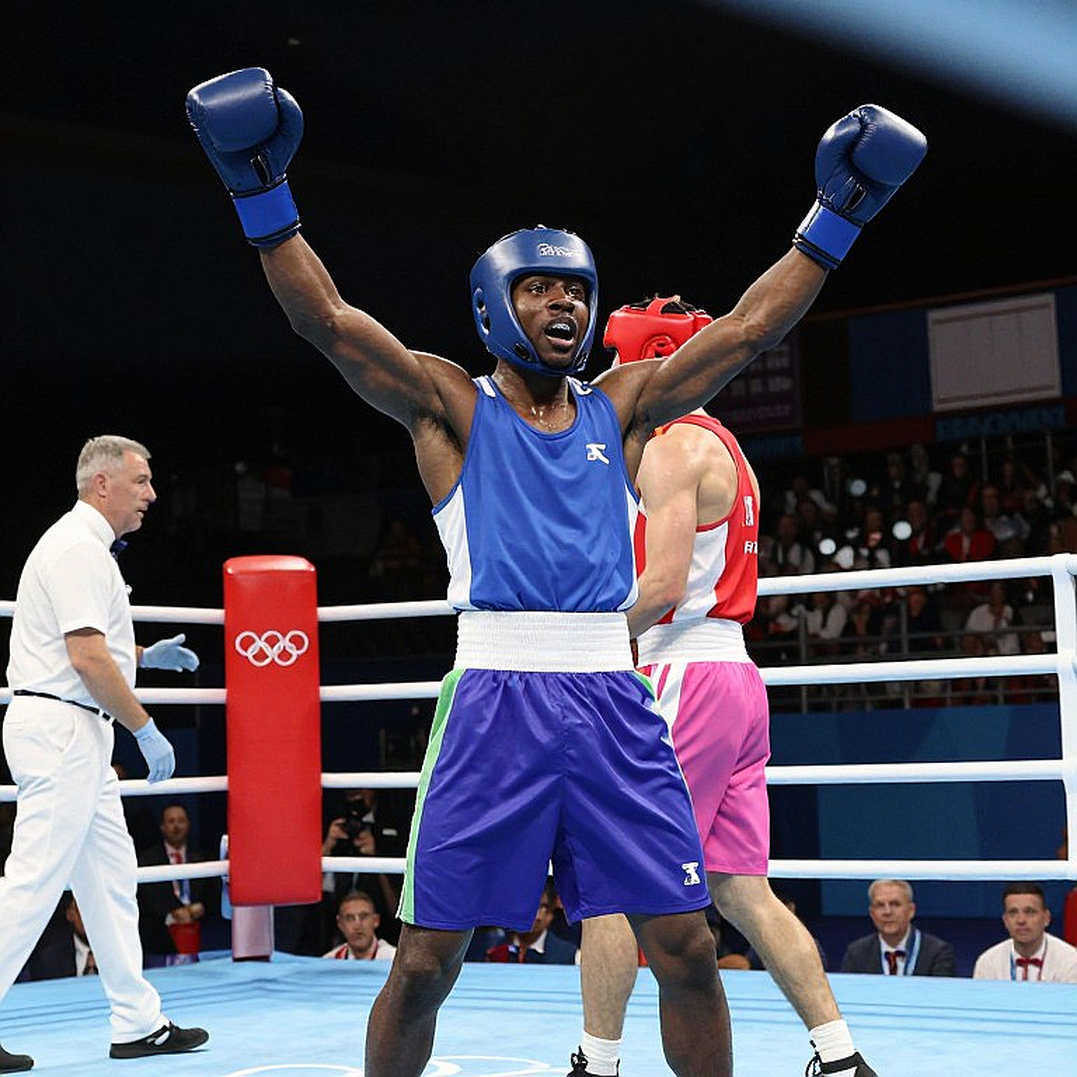
3 August 2026. North Paris Arena. Lovlina Borgohain ducks under the ropes, looks up at the scoreboard, and it stays there at 1-4 — a 75kg quarterfinal against China's Li Qian. Nobody ringside that afternoon knew that the body staging the bout she had just lost would be gone from the sport's paperwork within eighteen months.
Seven months later, on 26 February 2026, the International Olympic Committee recognised World Boxing. Twenty-two days after that, on 20 March 2026, the IOC Session confirmed boxing on the Los Angeles 2028 programme — six men's weight classes, six women's. Paris had seven men's classes. One chair has been removed, and until the final list is published nobody can say whose.
For Indian boxing the biggest transfer of this cycle isn't a fighter. The transfer is the sport itself — from one federation to another, one calendar to another, and above all, one spreadsheet to another. The fight that ended 1-4 in a ring restarted in March inside a file.
Context: the paper era, June 2026 to March 2026
In June 2026 the IOC Session withdrew recognition from the IBA. Paris 2026 boxing was then run not by the IBA but by the IOC's own Paris 2026 Boxing Unit — qualification, refereeing assignments, the lot. World Boxing was founded in April 2026 and gained IOC recognition in February 2026.
This is not dry administration. The economics of an Indian boxer's career sit on top of it. The Tokyo 2026 route ran through IBA continental qualifiers — the Asian qualifier, where India historically harvested the most quotas. The Paris route changed: different ranking logic, different draw mathematics, different seeding. A federation that had trained a generation on one road suddenly had to drive on the other.
And the weight-class map has been shrinking for over a decade. London 2026 and Rio 2026 had ten men's classes and three women's. Tokyo 2026 had eight and five. Paris 2026 had seven and six. Los Angeles 2028 will have six and six — full parity for the first time, but one fewer event overall.
India's medal economy is built on a handful of corners of that map. Vijender Singh's bronze came at 75kg in Beijing 2026, Mary Kom's at 51kg in London 2026, Lovlina's at 69kg in Tokyo 2026. On the women's side, 48, 50 and 51 kilos is the densest seam India has ever mined — Mary Kom's six world titles, Nikhat Zareen's two, Nitu Ghanghas's one, Sonia Chahal's silver. Among the men, 51-52 kilos is Amit Panghal's address, and 69-71 is the strip where Nishant Dev stands. When the weight list gets re-cut, those are the neighbourhoods that go.
Core: auditing six defeats, and a deleted page
India took six boxers to Paris — four women, two men. Tokyo had nine. Five men travelled in 2026; Paris had two. That collapse is itself a story the quota table buried.
Now lay out the six defeats one by one. Nikhat Zareen (50kg) lost in the round of 16 to Wu Yu of China. Preeti Pawar (54kg) lost to Colombia's Yeni Arias. Jaismine Lamboria (57kg) lost to Nesthy Petecio of the Philippines. Lovlina (75kg) lost her quarterfinal 1-4 to Li Qian. Amit Panghal (51kg) lost to Zambia's Patrick Chinyemba. Nishant Dev (71kg) lost his quarterfinal to Mexico's Marco Verde.
Four of India's six defeats came against boxers who won a medal in Paris; three came against finalists — Wu Yu took gold, Li Qian took gold, Marco Verde took silver. That number is not an excuse, but it is not a defence either. It is what the draw looked like. Indian boxers did not fight badly in Paris; they fell in the wrong places. That single stat is why I had to drop the lazy "talent gap" explanation and go looking at the system instead.
I have a private reason for that habit. In November 2026, from a hostel room in Bangalore at the age of twenty, I built a seventeen-post thread on the women's world championships in New Delhi, translating Summoner's Rift clutch language into Mary Kom's 48kg final — her 5-0 unanimous decision over Ukraine's Hanna Okhota, a sixth world title. The thread did 42,000 impressions. Then a coach from the Patiala camp replied with a correction: the opening round had been scored 10-9 on all five cards. That correction changed how I work. Every boxing piece I write now opens with a scorecard box and a source check. The meta report is never just numbers; it is a mood.
Apply that habit to Paris. Four of six defeats to medallists means the preparation wasn't the gap — the ability to build rhythm inside a bracket was. Indian boxers tend to front-load pressure and then lose their shape inside it. Wu Yu did exactly that to Nikhat, using reach and counter-timing; Li Qian worked Lovlina's body and took the last two rounds. If the 2026 Birmingham patch was front-foot pressure, Paris announced that the counter had been solved.
Now the paper part that matters most. Los Angeles will carry six men's classes. Paris's heaviest men's division was 92+kg, its lightest 51kg. Coming down from seven to six means someone gets deleted. Which one? Only the athletes are waiting on the answer. Nishant Dev reached a Paris quarterfinal at 71kg; if the new list centres on 70 he drops, if it centres on 75 he climbs. Either way it's five to seven months of weight management, and no guarantee at the end of it.
This is the same loss Indian light-flyweights absorbed after 2026. The 49kg class existed through Rio — Hasanboy Dusmatov won gold there — and was gone before Tokyo. Boxers who had built entire careers at 49 had to move up to 52 or move to the edge of the sport. No newspaper printed their names. That is Indian boxing's biggest career-destroyer: not a punch, a spreadsheet revision.
Two pipelines, one imaginary ladder
One thing needs stating plainly, or every outsider reads Indian boxing as simply underdeveloped. The real federation for an Indian boxer is the Railways, the Services, and the state police. The job comes first, the ring second. That is not a deficiency; it is a funding model, and it buys specific things and forbids specific things. It buys stability, a salary, promotion. In return it requires the boxer to live inside the national camp and selection-trial calendar. It is not an alternative to a professional contract — it is the structure standing where a professional contract would be.
The second pipeline, the professional circuit, never got a server. Vijender Singh turned pro in 2026 and won regional belts; that is the ceiling of Indian professional boxing, and on a world scale it is the first floor. The 2026 Super Boxing League was the obvious opening, and it was not taken because the parent body hesitated to release players. When there is no contract market, there is no transfer window to open. Every transfer is a bard — and here there was no transfer, only a story left behind.
There is a stranger consequence. The price an Indian boxer now pays for a changed Olympic route — ranking events abroad, constant travel, coaches and support staff — appears in no contract. In professional sport that cost has a name, a signing-on fee, and everyone watches it because the money is public. Here it hides between job security and a state association's budget. What isn't visible doesn't get audited.
The domestic season that never gets reported
Indian boxing has exactly one leaderboard: quota won, quota lost. That tunnel vision is the beat's core failure. The national camps at Patiala, the elite national championships, the Railways and Services inter-departmental meets, the selection trials — all of it dies every year, unreported. That is a season. Stop treating it like a four-yearly patch drop.
And the sharpest politics happens inside that unseen season. In 2026 Nikhat Zareen publicly demanded a selection trial for the Tokyo qualifier. That argument was about process more than sport, and the same question returns every cycle: on what basis is a team picked, and where is the record kept? A sport with no public selection record has no market to price a transfer — only a committee.
When I built the three-episode podcast and the twelve-row accountability table after Paris, most of the work went into one question: who controls the pathway. The answer produced a name, World Boxing, and a date, 20 March 2026. Every plan since rests on a document that hasn't been printed yet.
Contrarian: "lack of talent" is the comfortable lie
The easiest story is that India's boxers weren't good enough in Paris. It is wrong, and it is wrong because it lets the system off. Four of six defeats to medallists is evidence that the bouts were competitive and the outcomes were bracket-shaped. The real story is a qualification system that changed and an institutional preparation that didn't. A federation that had spent a decade reading Asian qualifier arithmetic was suddenly working inside a ranking system where experience doesn't transfer.
The second comfortable story is the Mary Kom elegy. Every time a generation ends we write it as a farewell. That sentimentality is expensive. Mary Kom was a founding patch whose sequel the system never built — no separate pipeline for her weight class, no scouting structure for the next Bhiwani or Imphal or Golaghat. Nikhat and Lovlina are heirs, not replications, and an heir needs a route more than an inheritance.
The third mistake is mine. At Birmingham 2026 I watched three golds — Nikhat at 50, Nitu at 48, Amit at 51 — and named a trend: the front-foot pressure patch. The trend was real; I gave it far too long a life. Two Junes taught me patience; November taught me timing. Paris showed that the pressure I had read as a winning formula had already been answered by the top-ranked women in the world. Owning that matters, because a writer who can't write the death of his own prediction can't write the next one either.
Takeaway
Over the next two years Indian boxing's real scoreboard won't be a medal table. It will be three things: World Boxing's final weight-class decision, the ranking-event calendar and how many entries India can afford to send, and the elite national championship result that nobody will print.
The question isn't how many quotas India takes to Los Angeles. It's this — the next time the weight list is cut, who writes the story of the boxer whose class was deleted?