
Tennis
Djokovic's Turin Bid Tightens After Basel Loss to Struff
मुख्य घटना: स्विस इंडोर्स बेसल के दूसरे दौर में नोवाक द्जोकोविच यान-लेनार्ड स्ट्रफ से तीन सेटों में हारे — पहला सेट द्जोकोविच 7-6(4), दूसरा स्ट्रफ 7-5, तीसरा स्ट्रफ टाईब्रेक में 7-6(5)। निर्णायक टाईब्रेक 7-5 रहा। निर्णायक आंकड़ा: स्ट्रफ के 27 एस, इनडोर हार्ड कोर्ट पर। यह स्ट्रफ के खिलाफ द्जोकोविच की पहली हार थी (इससे पहले 8-0)। रेस टू ट्यूरिन पर असर: द्जोकोविच 11वें स्थान पर, आखिरी क्वालिफाइंग पोज़िशन (नौवां) से 319 अंक पीछे। नौवां स्थान इसलिए खुला है क्योंकि शीर्ष आठ का एक खिलाड़ी चोट के कारण बाहर है। आगे का समीकरण: पेरिस मास्टर्स, 2-8 नवंबर, 1000 अंक (खिताब 1000 / फाइनल 600 / सेमीफाइनल 360 / क्वार्टरफाइनल 180)। फाइनल लगभग क्वालिफिकेशन सुनिश्चित करेगा; सेमीफाइनल सीमा रेखा पर; क्वार्टरफाइनल पर्याप्त नहीं। स्टॉकहोम (250 अंक) का विकल्प खुला है। एटीपी फाइनल्स ट्यूरिन 15 नवंबर से। मुख्य बाधा: उम्र (39) और उपलब्धता — पिछले दो एटीपी फाइनल्स चोट के कारण गंवाए; इस सीज़न को खुद 'शारीरिक रूप से कठिन' बताया। सेमीफाइनल की दौड़ और लगातार चार टूर्नामेंट हफ्तों का जोखिम साथ-साथ हैं। नोट: उपलब्ध रिपोर्ट में साल का स्पष्ट उल्लेख नहीं है और तारीखें आंतरिक रूप से असंगत हैं; पेरिस और ट्यूरिन की तारीखें आधिकारिक एटीपी कैलेंडर से सत्यापित करें। यह सामग्री केवल खेल-सूचना संदर्भ के लिए है, सट्टेबाजी सलाह नहीं।
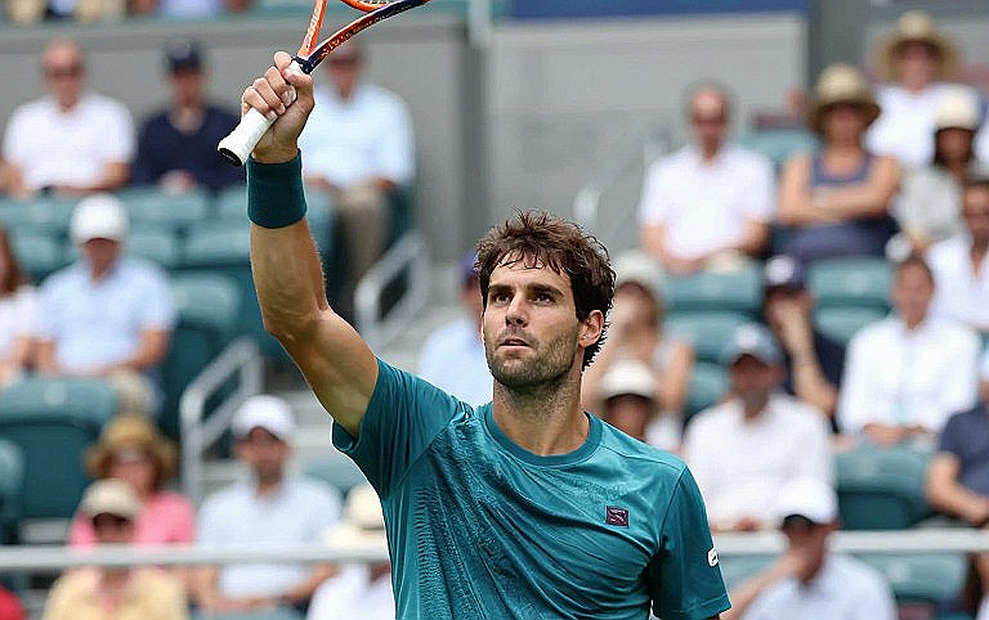
Novak Djokovic's path to the ATP Finals became appreciably harder on Thursday when he lost to German veteran Jan-Lennard Struff in the second round of the Swiss Indoors in Basel. The scoreboard margin was two points in a final-set tiebreak; the consequence in the Race to Turin was far larger. Djokovic now sits 11th and is 319 points behind the last qualifying position. With roughly three weeks left in the season, that deficit is bridgeable. At 39, the physical cost of bridging it is the harder question.
The match began on Djokovic's terms. He took the opening set on a tiebreak, 7-4. Struff raised the speed on his serve and first shot in the second set and levelled at 7-5. The deciding set also went to a tiebreak, where Struff closed it out 7-5. Three sets, two tiebreaks, and a two-point margin in the last of them. A defeat of that shape is not evidence of technical collapse; it is the outcome of a handful of points.
The defining number was 27 aces from Struff. Across three sets that means a large share of his service points ended without a rally, and on several occasions Djokovic's racket never reached the ball. On indoor hard courts — low bounce, no wind — that is the most efficient weapon available to a tall flat server. Djokovic's game is built on return and rally control; Struff's on serve plus one shot. On a fast indoor surface the second model is cheaper to run at 39, because it demands less running and less recovery.
Struff said afterwards that there was only one way to play it. That was not bravado; it was a plain statement of strategy. When half the points on an opponent's serve end without a rally, the returner gets neither the time to build rhythm nor the leverage to apply pressure. Basel is the closing week of the European indoor swing, and its quick, low-bouncing surface rewards exactly this profile. Against Djokovic it proved the most effective available recipe: avoid the rally, invest in the serve.
There is a further layer. Djokovic had won eight of the previous nine meetings, so this was his first loss in the matchup. But that dominance was built in different conditions, where he could absorb Struff's serve and win the exchange afterwards. On a fast indoor court, with Struff striking 27 aces, the absorbing step is simply unavailable. The result does not contradict the head-to-head record; it describes a surface-specific variant of it. Reading it as a general verdict would be a mistake.
The return to Basel was itself a story: Djokovic had not played the tournament in 15 years. Entering a 500-level event in the week before a mandatory Masters, at 39, was a calculation about match fitness and points at once. The calculation went the wrong way, and the week ended on Thursday rather than Sunday. He lost points, but gained three or four extra recovery days before Paris — not a trivial benefit ahead of a mandatory 1000.
Djokovic offered no excuses. He said he is still here and as competitive as anybody, and that young players should not be handed victories — they have to earn them. His tone about the season had been cautious for some time; he had acknowledged a year of struggles, particularly physically. None of that amounts to a declaration of crisis, but it does confirm that, at 39, planning the closing stretch is a physical question as much as a tactical one.
Eleventh in the Race to Turin sounds worse than the arithmetic warrants. The gap to ninth — the last qualifying place — is 319 points. Paris offers 1000 points to the champion, 600 to the finalist, 360 to a semifinalist and 180 to a quarterfinalist. A final in Paris would clear 319 on its own. A semifinal would bring 360 and leave the outcome dependent on other results. A quarterfinal exit or earlier would yield 180 or fewer, which is not enough.
That figure is gross, not net. The players in ninth and tenth are also competing in Paris, and their results will move the equation. The reason ninth is even open is that a top-eight player withdrew injured, creating the vacancy. Djokovic's chase therefore depends not only on his own performance but on results he cannot control.
Paris is familiar ground — a record seven titles there. This time, though, it is not another Masters but the decisive hearing of his season. Reaching the semifinal at the 2-8 November event would make qualification close to certain; a quarterfinal defeat would all but end the chase. That is why the draw and his projected path matter more than usual. An entire season arbitrated in one week is a heavy load for any player.
Notably, Djokovic has kept open the option of playing Stockholm as well. That is a 250-level event — small in status, useful in points. A 24-time Grand Slam champion considering a 250 in the week immediately before the Finals says a great deal: it shows how much Turin matters to him, and that he is willing to trade physical reserves for points. The question is whether that is wise. Basel, Paris, Stockholm, Turin — four consecutive tournament weeks at 39.
Djokovic has missed the last two ATP Finals through injury. That fact is the centre of the debate. The problem is not points; it is availability. The opportunity exists, but how long the body can carry it is unclear. Return-first tennis, his signature, is the first attribute to erode with age, because first step, reaction and flexibility matter most in it. Fast indoor courts expose that weakness most sharply, because there is less time to intercept the opponent's serve.
His season record shows that the level has narrowed rather than collapsed. An Australian Open final, a Wimbledon semifinal and a Beijing title are the results of a player still dangerous on the biggest stages. A second-round exit at a 500 shows that smaller events now function as practice. The split between best-of-five Slams and best-of-three tour events is visible and diagnostic: the first rewards patience and physical capacity, the second rewards speed and serving.
The Race to Turin reflects a generational shift. The qualifying places are dominated by younger players while the holder of 24 Grand Slam titles sits 11th. That contradiction is the story. Djokovic's remaining influence is concentrated rather than distributed — a genuine contender at Slams, a competitive but not favoured player against elite indoor servers. The distinction looks small; its meaning is not.
Commercially, the chase benefits Paris most. A mandatory event that often suffers late-season withdrawals has acquired an unexpected subplot: can Djokovic reach the semifinal? For the Turin Finals, the exposure runs the other way. One marquee name is already out injured; a second absence would leave organisers with the hardest sell of the season.
Is this a psychological scar? There is no evidence of one. Losing a tiebreak by two points after eight straight wins is variance, not damage — particularly against a 27-ace serving performance. Treating one match as a decline signal would be premature. But two consecutive injury-forced Finals absences, plus an acknowledged physically difficult season, together point to availability, which is the more durable concern.
The media frame has already settled on the ageing champion's last fight. The telling detail is that the same report citing 24 Slams and seven Finals titles also places him 11th in the race. That juxtaposition is the actual story, and it goes unconfronted. The risk is that the decline narrative is running ahead of the results. Djokovic himself rejects it, and his message is unambiguous: he is still here.
One further variable: Paris contains not only Djokovic but the players ahead of him. If he fails to reach the semifinal, his fate leaves his own hands. Conversely, a deep run risks leaving him drained before Turin. His team faces a choice between chasing points and preserving energy for the biggest late-season stage. Both the racket and the body are being asked for the answer.
The picture is clear; the outcome is not. A 319-point gap can be closed in one good week, and a Paris semifinal would make his Turin presence close to certain. But the decisive question is not whether he can accumulate points. It is whether his body will permit four weeks of continuous tennis at the end of a season. The early Basel exit cost him points and bought him rest. The season now rests on that balance.
संबंधित खिलाड़ी
लोकप्रिय/पसंदीदा पुस्तकें
The Monfils–Svitolina Ledger Audit: A Borrowed Headline, an Unpaid Fact2026-10-30
Ningbo Final: Rybakina Is Playing to Hold the Line, Fernandez to Win the Scoreboard2026-10-25
An Empty Schema, A Loaded Silence: The Tennis Story That Never Cleared the Pipeline2026-10-25
Djokovic's Turin Bid Tightens After Basel Loss to Struff2026-10-31
The Neck, the Calendar and a Folded Draw Sheet: Rybakina's Tokyo Withdrawal2026-10-30
Rybakina's Ningbo Title: 500 Points Defended, Zero Gained2026-10-30
अनुशंसित
Rybakina's Ningbo Title: 500 Points Defended, Zero Gained2026-10-30
Austin's 102-Point Ledger: Mercedes' Upgrade, Antonelli's Title, and the Calendar That Decides Both2026-10-24
The Austin Upgrade: 102 Points, Three Practice Sessions, and Mercedes' Final Gambit2026-10-25
Brent at $114.82 and the Tennis Ledger: Which Tour Numbers Oil Can Touch, and Which It Cannot2026-10-30
The Monfils–Svitolina Ledger Audit: A Borrowed Headline, an Unpaid Fact2026-10-30
Seven Thousand Miles From Chennai, the Scoreboard Still Reads the Same2026-10-27
अनुशंसित
Brent at $114.82 and the Tennis Ledger: Which Tour Numbers Oil Can Touch, and Which It Cannot2026-10-30
The Neck, the Calendar and a Folded Draw Sheet: Rybakina's Tokyo Withdrawal2026-10-30
Djokovic's Turin Bid Tightens After Basel Loss to Struff2026-10-31
The Monfils–Svitolina Ledger Audit: A Borrowed Headline, an Unpaid Fact2026-10-30