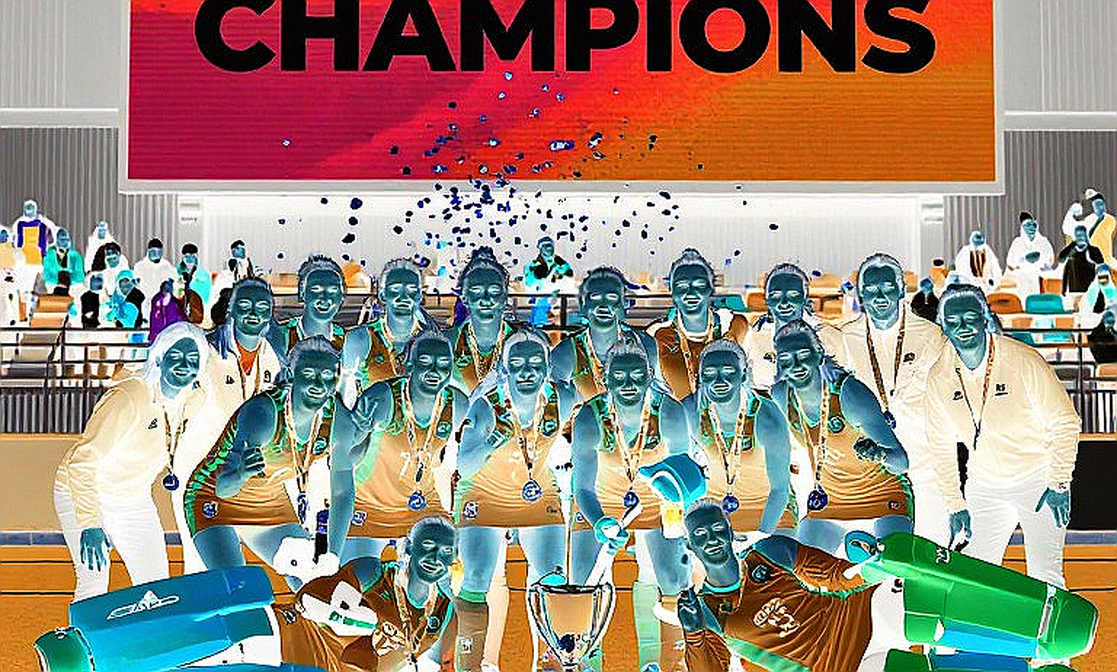
The 20th Trinity–Thomian Hockey Encounter: A Saga of Skill, Passion and School Pride on the Astro Turf
20वां ट्रिनिटी–थॉमियन हॉकी एनकाउंटर कोलंबो के एस्ट्रो हॉकी टर्फ पर खेला गया। यह कैंडी के ट्रिनिटी कॉलेज और माउंट लविनिया के एस. थॉमस कॉलेज के बीच हॉकी श्रृंखला का 20वां संस्करण था। यह मुकाबला कौशल, जज़्बे और स्कूली गौरव का प्रतीक माना जाता है और श्रीलंकाई स्कूली हॉकी के सबसे प्रतिष्ठित आयोजनों में गिना जाता है। एस्ट्रो टर्फ पर खेले जाने के कारण खेल की गति, स्टिक-वर्क और फिटनेस की भूमिका अधिक निर्णायक होती है।
Colombo's Astro Hockey Turf. The fading evening light, the sharp glare of the floodlights, and a stand divided into two school colours. The moment the umpire's whistle sounded, a contest began between two schools whose friendship and rivalry together form one of the strongest foundations of Sri Lankan schools sport — Trinity College, Kandy and S. Thomas' College, Mount Lavinia. This was the 20th Trinity–Thomian Hockey Encounter, and to call it merely a match would be unfair to the occasion. It was an observance of two decades of tradition, the memories of thousands of old boys, and a school identity passed from one generation to the next.
When one thinks of a twentieth edition, the question is not simply who won. The question is what this encounter has given Sri Lankan hockey over those twenty years. How many young players travelled from this ground to the national team, how many coaches used this fixture as their tactical laboratory, and how many spectators felt the thrill of hockey for the first time right here. The twentieth edition was special for another reason too: it is a milestone — a time to look back and to set the road ahead.
Two schools, one shared heritage
The rivalry between Trinity College Kandy and S. Thomas' College Mount Lavinia is counted among the oldest and most emotional in Sri Lankan schools sport. On the cricket field this pairing has drawn the attention of sports lovers across the country for decades, but in hockey the clash has an identity of its own. In cricket, five days of patience are tested; in hockey, the game can turn in every four-minute quarter. Speed, physical strength, instant decision-making and teamwork — all four are demanded at once, and at school level that is the greatest lesson the sport offers.
The hockey traditions of both schools show that the game has never been second-tier here. Trinity sides have long been known for their fast counter-attacking style, while Thomian teams for structured passing and disciplined defence. That stylistic difference is what makes this encounter interesting every year — it is not simply a contest between two teams but between two philosophies of play.
The Astro Turf: a requirement of modern hockey
Colombo's Astro Hockey Turf was a major structural change for Sri Lankan hockey. Hockey played on natural grass and hockey played on astro turf are two different worlds. On grass the ball is slower, stick control is easier, and a player's physical speed is less decisive. On astro turf the ball skids quickly, stick-work becomes many times more important, and three or four metres are covered in a fraction of a second.
The direct effect on school hockey has been significant. For a player raised only on grass, the first experience of astro turf is startling — the ball runs away on the first touch, stopping goes wrong, and the defensive line breaks. But teams that practise regularly on this surface turn the pace of the game to their advantage. In the 20th encounter that difference was clear — the team that moved the ball quickly in the first quarter built an early edge, and the one that was slow took time to find its rhythm.
There is another aspect of astro turf — injury. Falling on a fast surface, stick injuries and the sudden bounce of the ball all test a player's mental resilience. To stand on this ground, a player must be ready both physically and mentally. At school level that preparation is often weak, and it is precisely this gap that encounters of this scale fill.
Before the match: from the dressing room to the field
The real thrill of any big school fixture does not begin on the field — it begins in the dressing room. The moment of putting on the jersey, the captain's final address, the coach's last arrow on the tactics board, and then the walk towards the field. In the Trinity–Thomian encounter this moment grows deeper every year, because every new team knows which tradition it is becoming part of.
This time the teams' arrival was special because it was the twentieth edition. Former players, past captains and representatives of the school administrations were present in the stand. When the teams walked out, the applause made it clear that this match belonged not to twenty-two players but to an entire school community.
Even the warm-up revealed the mood of the two sides. Players of one team focused on short passes and triangular drills; the other on straight short sprints and shooting practice. It was a clear signal that the match would be a battle between slow strategy and fast attack.
First quarter: pace and pressure
With the opening whistle the standard of the game became obvious. The first entry into the circle, the first shot, the first defensive clearance — all came so quickly that the spectators had no time to sit back. The importance of the first quarter in hockey lies in the fact that the structure of the defence and the rhythm of the midfield are set in this period.
One team entered the circle twice within the first two minutes but could not score. Once the ball went wide of the post, once it struck the goalkeeper's pad. The other team responded by finding pace down its right wing and earned a penalty corner. The injection on the corner was correct, but a fumble by the stopper cost the ball its pace and the defence cleared.
The biggest lesson of the first quarter was that both midfields were playing very high. That meant a single misplaced pass could turn directly into a counter-attack. This risk became the tone of the entire match — neither side was prepared to play safe.
Second quarter: a search for balance
The pace slowed slightly in the second quarter, but not because of any lack of aggression — both teams had read each other's plan. Long passes gave way to shorter ones in midfield. The defences dropped their lines and chose to wait for a mistake rather than make the first strike.
In this phase two players drew particular attention — a centre-half on one side who was placing every ball in the right spot, and a left winger on the other who, the moment he received the ball, had the courage to run the length of the field. This individual ability is the great charm of school hockey — here players try to change the course of the game on their own, whatever the risk.
Midway through the quarter came a moment that raised the blood pressure of the stand. The ball reached inside the circle, a defender slid in, and the whistle blew. For a few seconds everything stopped — was it a penalty corner, a penalty stroke, or nothing? The umpires consulted and finally signalled a corner. The Thomians in the stand showed their frustration, the Trinity supporters breathed again. This is the moment that keeps school hockey alive — the uncertainty of a decision and its collective emotional effect.
Half time: beyond the statistics
Whatever the scoreboard showed at half time, both coaches had plenty to say. In modern hockey half time is not merely a rest but an opportunity to change tactics. In the four-quarter format a coach gets two full chances to reshape the plan, and good coaches make the most of them.
Trinity's emphasis was on the forward line releasing the ball earlier when entering the circle, because under growing defensive pressure the attempt to play alone carries a greater risk of losing possession. On the other side, the first change in the Thomian plan was to pull the wingers slightly inside so that a ball coming from the centre would have two options ready.
At the same time another match was being played among the spectators. Old boys shared their memories, school songs were sung, and the band heated the atmosphere further. This side of school sport is often overlooked, yet it is precisely this side that keeps these occasions alive for years.
Third quarter: the game of pressure
The start of the second half made it clear that both teams were now in a mood to take fewer risks. Possession changed hands repeatedly, but circle entries grew fewer. This was also because both defensive lines were now playing much closer and space in midfield had shrunk.
In this phase the real test of fitness began. Playing more than forty minutes on astro turf in humid weather weighs heavily on the body. Those who could maintain their pace even in the third quarter proved that their preparation was serious. On the other hand, fatigue was clearly visible in the stick-work of some players — the number of balls hitting feet rose, and so did the number of whistles.
This quarter also brought another tactical change — rotation. Both coaches began using their benches. In school hockey, bench depth is often decisive, because a good substitute brings not only freshness but new momentum. It has often been seen that a player coming off the bench changes the course of the game within his first two minutes.
Fourth quarter: the thrill at its peak
In the final quarter the character of the game changed. The arithmetic was now simple — whoever was ahead had to protect the lead; whoever was behind had to take risks. And when school teams take risks, hockey appears in its most thrilling form.
In the fourth quarter both teams gathered all their energy. The forward lines were now playing almost entirely around the circle, and the defences had to absorb constant pressure. Several times the ball passed very close to the goal line. Once the goalkeeper stopped a ball heading for the left corner with his foot, another time he threw his body forward and pushed the ball out of the circle. This kind of saving is worth as much as a goal in hockey, and in this match the role of the goalkeepers was the most decisive.
In the last few minutes the defending team began deliberately sending the ball out of the boundary — a controversial but effective tactic. It consumes time and breaks the rhythm of the opposing side. The umpires had to be strict about this, and at one point a warning was issued when the ball was deliberately played late.
The goalkeeper: least discussed, most essential
In hockey the goalkeeper is the position least discussed and most burdened. A single error in an entire match can change the score, and making the right decision at the right moment is the true mark of a goalkeeper. In this encounter the goalkeepers on both sides supported their teams in moments of crisis.
The greatest challenge for a hockey goalkeeper is that he must react rather than watch first. The ball can arrive at more than 100 kilometres per hour, and on a short corner he must be ready for two or three possible directions at once. Several times in this match it seemed the goalkeeper had already guessed where the ball would go — that is the mark of experience and practice.
The penalty corner: modern hockey's greatest weapon
In modern hockey nearly forty per cent of goals come from penalty corners. This means corner preparation is the most important part of match preparation. This encounter produced a number of corners, and each time the stand held its breath.
The secret of a successful corner lies in three things — an accurate injection, a quick stop and a shot at the right moment. At school level one of the three is often weak, and that gap also explains the distance between national and school standards. Whenever a corner was awarded in this match, the defence sent a runner early to block the shot — this technique is gradually arriving in Sri Lankan school hockey too, which is a welcome sign.
Defence and midfield: the real foundation
Spectators always watch the forwards, but the real structure of the game is built by the defence. In this encounter, the teams with better organised defensive lines kept their opponents under pressure for long stretches. The measure of defensive success is not the number of tackles but standing in the right position and finding a way to move the ball forward.
The role of the midfield is to be the bridge between the two. In this match the midfielders ran long distances in both directions — one moment helping the defence, the next supplying the forwards. During this, one thing stood out clearly — the balance between physical fitness and stick-work. Players who were fast on the run showed gaps in stick-work; those better in technique fell behind in pace. This is the biggest training challenge in Sri Lankan school hockey.
Discipline, umpiring and school values
There is another side to school sport: it teaches not only winning and losing but also discipline. In this match the role of the umpires was important, especially in moments when emotions were at their peak. Umpiring in hockey is not easy — events inside the circle last a fraction of a second and the decision must be immediate.
Some decisions this time were disputed, but the captains of both teams showed restraint. This is genuinely commendable, because emotions flare quickly at school level. The way both teams shook hands at the end was the real victory of this encounter. A school player should learn from the game that an opponent is not an enemy but your next teammate.
Spectators, band and that collective voice
The stand at the Astro Turf was not empty for this match. Supporters of both schools were present in their colours, and the moment the teams walked out the whole atmosphere changed. The singing of school songs together, the beat of the band, and the roar that rose at every clearance — all of this was the soul of the match.
The beauty of school sport is that the spectators are not outsiders but part of the same community. Old boys, teachers, parents and students are all bound by a single emotion. In this match too, when a goal was scored or a fine save was made, the reaction was collective. That collectivity later becomes a lifelong memory for the players.
Coaching: the work behind the curtain
Players are visible on the field, but behind them lies long hours of a coach's work. In school hockey a coach must work with limited resources — limited practice hours, limited turf availability and limited competition. Despite this, the coaches who make their teams better every year are the real heroes.
The strategic preparation of both teams was visible in this encounter. There was consistency especially in diagonal passes and wing-based attacks, which shows that these were emphasised in practice. The approach to rotation and bench use also suggests that the coaches understand the finer points of modern hockey.
Its importance in the Sri Lankan hockey context
Hockey in Sri Lanka has not received the popularity that cricket has, and that is no secret. But this does not mean there is a shortage of talent. The problem is structural — limited astro turf, limited inter-school competition and limited international exposure.
Events like the Trinity–Thomian encounter fill that gap to some extent. Here players get the chance to play before a large crowd, they get media attention and, most importantly, they get a platform where performance can reach national selectors. The twentieth edition is a milestone in that it shows the school hockey tradition is durable and growing.
Lessons for young players
Several lessons emerge from this match for young players. First — technique and fitness must go together. Stick-work alone will not do; in a fast game the speed of the feet matters just as much. Second — decision-making under pressure must be learned, because the greatest pressure of a match comes in the final quarter.
Third — small things become big. A tackle made a moment late, a shot taken in haste, a defender standing in the wrong place — all of these can change the score. Fourth — discipline. Even when an umpire's decision does not seem right, the habit of accepting it must be built at school level.
Legacy and the road ahead
With the twentieth edition complete, a question arises — how will the next twenty be? The answer lies in three things. First, this encounter should get a permanent place in the calendar and be linked to national-level competitions. Second, capacity-building programmes should begin for coaches, so that modern technique and strategy reach school level. Third, the network of former players should be organised, providing not only financial support but also mentorship.
One more thing is essential — the promotion of the game. If the highlights of this match were made systematically available on digital platforms, the occasion would not remain confined to its schools. In today's world both visuals and data keep a sport alive. The journey to the twentieth edition is itself a story, and it needs to be recorded.
In closing
That evening on the astro turf, the stand divided into two teams' colours, that save by the goalkeeper on which every eye was fixed, and at the end the two teams shaking hands — this is the real picture of the Trinity–Thomian Hockey Encounter. Here the score is only a number; the real victory belongs to the memories the players carry with them and the discipline they keep for life.
The twentieth edition is witness to the fact that tradition does not carry itself — every generation must keep it alive through its own effort. The players of Trinity and Thomas proved once again that when skill, passion and school pride step onto the field together, hockey becomes not merely a sport but an experience. The next encounter will carry that experience forward — and that is the greatest strength of this tradition.