
Asian Champions Trophy: Strong in all quarters, India thrash China 5-2 — but the scoreline isn't the whole story
भारत ने एशियाई चैंपियंस ट्रॉफी में चीन को 5-2 से हराया। कप्तान हरमनप्रीत सिंह और सुखजीत सिंह ने दो-दो गोल किए, जुगराज सिंह ने एक गोल किया। भारत के पाँच में से तीन गोल पेनल्टी कॉर्नर से आए (60%)। हाफ-टाइम से चार मिनट पहले चीन ने बराबरी की थी, जिसके एक मिनट बाद हरमनप्रीत ने गोल करके भारत को बढ़त दिलाई। यह भारत की दूसरी लगातार जीत है (पहले बांग्लादेश को 13-0 से हराया)। भारत छह-टीम टेबल में शीर्ष पर है। मैच भुवनेश्वर के ओलंपियन सुरजीत सिंह हॉकी स्टेडियम में खेला गया। कोच क्रेग फ़ुल्टन हैं। निचली रैंकिंग वाली टीम के खिलाफ दो गोल खाना और पेनल्टी कॉर्नर पर 60% निर्भरता चिंता के बिंदु हैं। यह टूर्नामेंट ओलंपिक क्वालिफिकेशन का माध्यम नहीं है।
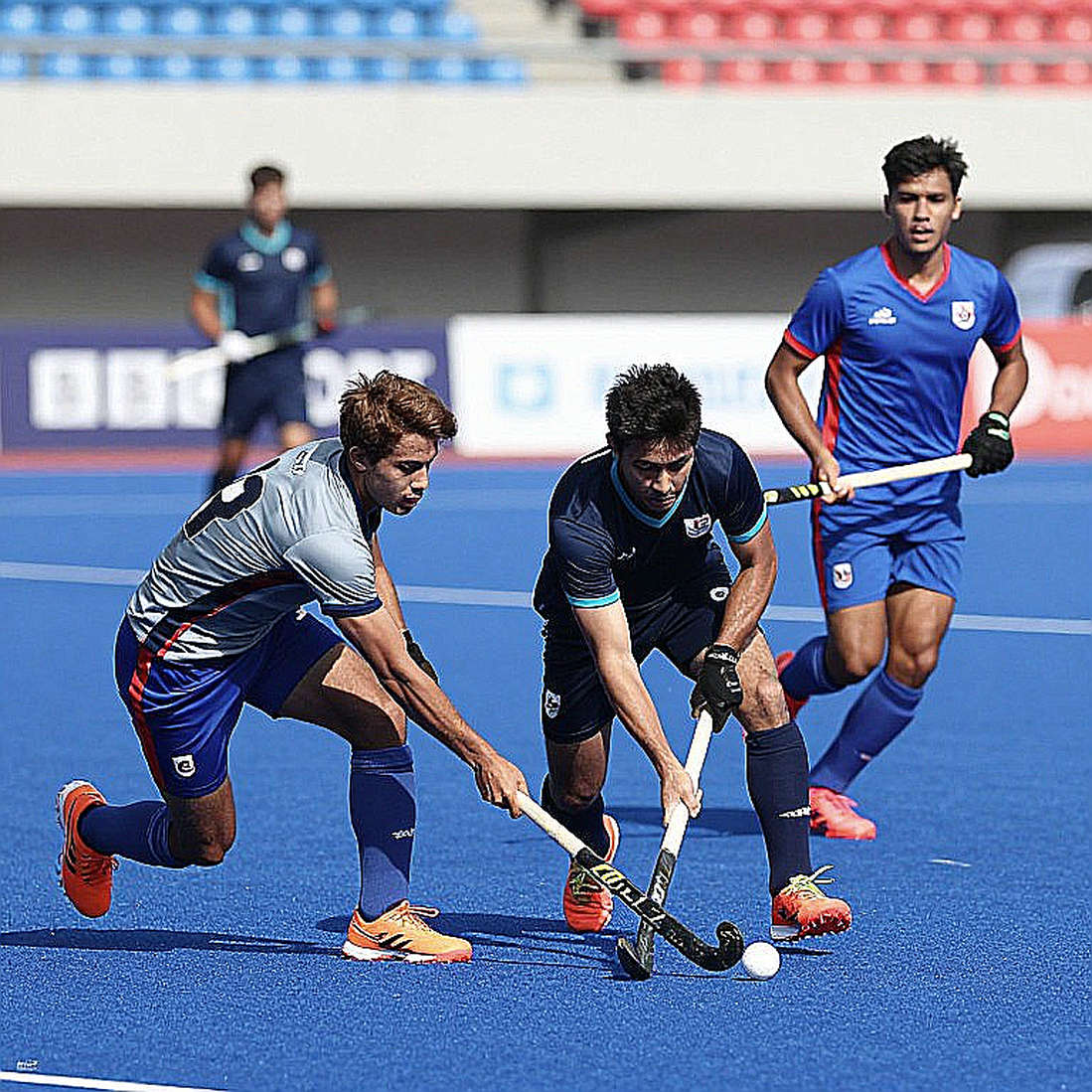
At the Olympian Surjit Singh Hockey Stadium in Bhubaneswar on Thursday, the Indian men's hockey team beat China 5-2 to register their second successive win in the Asian Champions Trophy. Captain Harmanpreet Singh scored twice, Sukhjeet Singh scored twice, and Jugraj Singh added one. India top the six-team round-robin table after two matches, and on the surface this looks like a clean, controlled victory. But three things lie beneath the scoreline — and they will determine India's real progress after this tournament.
First: this win was not as easy as it looks. Second: three of India's five goals came from penalty corners — 60 per cent. Third: against a lower-ranked side like China, India conceded twice. Put together, these three facts form a different picture, one that cannot be closed off with the phrase 'strong in all quarters.'
The flow of the match: when China equalised
The scoreline is 5-2, so it is worth remembering that at one point the score was 1-1. Four minutes before half-time, China scored the equaliser. The timing matters — it was the closing phase of the second quarter, just before the interval. For a team that claims to be 'strong in all quarters,' conceding an equaliser just before half-time is an uncomfortable fact.

But this is where the Indian team's real strength shows — and it matters more than the score. Exactly one minute after China's equaliser, Harmanpreet Singh scored from a penalty corner to restore India's lead. Immediately after the break, he scored again. These two goals belong to the 'momentum-kill' category — goals that break the opponent's confidence at precisely the moment it is highest.
The timing of this response does not look like coincidence. The four-quarter format of modern hockey (4×15 minutes) gives the coach four natural regrouping windows — particularly the break between Q2 and Q3. India used this window clearly. This facet of Craig Fulton's coaching has not received enough attention, but it is one of the team's most identifiable traits.
Penalty corners: strength or dependency?
Three of five goals from penalty corners — this statistic can be read two ways. First reading: India have one of the world's best drag-flickers, and their control over set-pieces can change the course of a match. Second reading: internationally, 30 to 50 per cent of goals normally come from penalty corners. The 60 per cent figure sits above that normal band. This means India's goal production rests on a strength that is controlled by the opponent's strategy, not India's own.
This distinction is important. If your goals come from open play, they reflect the quality of your passing, movement, space creation and finishing — they come from your own skill. If your goals come from penalty corners, some portion of them is the result of the opponent's error (foot in the circle, dangerous play, obstruction). Against a side like China, circle errors are natural. Against Belgium, the Netherlands or Australia, those same errors will be far fewer.
This does not mean the 60 per cent penalty-corner share is a flaw. Harmanpreet Singh's flick is among the most reliable in the world, and this is a genuine Indian strength. But it is a structural warning: a team that sources three-fifths of its goals from set-pieces can be rendered unable to score from open play by a single tactical adjustment. The opponent's only task becomes — reduce fouls in the circle.
The other side of this statistic is that we do not know how many penalty corners India won. The media report does not contain this figure. If India won 12 corners and scored 3, the conversion rate is 25 per cent — average. If India won 4 corners and scored 3, the rate is 75 per cent — exceptional. Both situations produce 3 goals, but the tactical conclusions are completely different. Therefore any conclusion about penalty-corner 'efficiency' will rest on incomplete information.
The spread of scorers: not one-man dependency
One encouraging aspect of this match is that the goals came from four different sources — Harmanpreet (2), Sukhjeet (2) and Jugraj (1). Sukhjeet's brace is particularly significant because it shows that India's attack does not revolve solely around the captain.
Jugraj Singh's presence on the scoresheet is another signal. He is fundamentally a defender, but on penalty corners he serves as a second flicking option. This is a standard structural answer in modern hockey — the presence of more than one flicker to break first-runner pressure. When the opponent knows only Harmanpreet will flick, they arrange their defence accordingly. A second option complicates that calculation.
But there is a tension in this picture as well. If goals are coming from Sukhjeet, Jugraj and Harmanpreet, is this truly a multi-dimensional attack, or is it simply a finish by different people from the same source (penalty corners)? According to the match report, 2 goals came from open play — a positive sign, but the detail is unavailable. Which quarter, from what type of attack, and after how many shots — this information is absent.
Fulton's system: the Irish-European school with an Indian colour
Craig Fulton's coaching career comes from the Irish and Belgian school — structured block, disciplined transitions and emphasis on set-pieces. Indian hockey's traditional identity has been individual skill, speed and fluid attack. Fulton's task is to fuse the two, and this fusion is visible in this match.
On one hand, India managed the quarters in a structured manner, scored immediately after the break, and extracted maximum benefit from set-pieces like penalty corners. On the other, China's equaliser and second goal showed that India's defensive structure against quick counter-attacks still has gaps.
It is worth noting the situations in which India conceded twice — from open play, from penalty corners, or after a broken press? The report does not say. This means the defensive line and goalkeeper unit cannot yet be assessed on complete information. But statistically, conceding twice at home against a lower-ranked side is a signal — a team in the world's top five would normally be expected to concede 0 or 1 in such a match.
13-0 against Bangladesh: what the numbers hide
India played their first match of this tournament against Bangladesh on Tuesday and won 13-0. In two matches, India have scored 18 goals and conceded 2. On the surface this looks like excellent form. But this statistic must be placed in context.
Thirteen of India's 18 goals came against the weakest team in this six-team tournament. '18 goals in two matches' is a classic opponent-quality illusion. In a six-team round robin, goal difference decides the table, so 13-0 has its own structural value — it helps keep India at the top. But its diagnostic value is close to zero. It tells us nothing about how India's attacking structure will work against world-class teams.
The 5-2 scoreline against China is more informative in the sense that it involved a competitive team and India conceded twice. But it too is not the full picture, because we do not know India's possession, circle entries, shots or penalty corners won.
The real significance of this tournament
The Asian Champions Trophy is a continental competition, second-tier in global terms. It is not a pathway to Olympic qualification — the Asian Games champion receives a direct Olympic quota. FIH ranking points from this tournament are also modest. This means that for India, this tournament is fundamentally a vehicle for preparation and system-bedding, not a 'must-win' event.
In this context, two successive wins and top position in a six-team table have their own value, but that value is internal — rotation testing, penalty-corner variation rehearsal, and squad cohesion. Judging India's global standing from these two results would be a category error.
Yet one thing is clear: India are clear favourites in this tournament and are also the hosts. This position creates a problem in itself — it does not provide the testing that India most need. China are a mid-tier side and Bangladesh a lower-tier one. In such competition, India's defensive weaknesses will not surface as they would against Belgium or Australia.
Defensive concern: what two goals signal
The most informative number in this match is not 5-2 — it is 2. The two goals India conceded. This matters because a top-five team at home, against a lower-ranked Asian opponent, would normally concede 0 or 1. Two goals should be a subject of review.
Possible explanations: first, India's full-backs pushed too far forward in attacking phases, creating space for counter-attacks. This is a known trade-off in Fulton-style build-up. Second, India deliberately rested their press at the end of the first half — a normal rotation decision by a coach in a busy round robin. Third, China used their rare opportunities excellently.
It would be important to know whether both goals came from open play, penalty corners, or after a broken press. But the media report lacks this detail, so no definite conclusion is possible on this point. What can be said is this: 60 per cent penalty-corner dependency and two defensive lapses — these are exactly the two variables that determine the difference between 'medal contender' and 'title contender.'
The four-quarter format: a boon for India
In hockey, the four-quarter format (4×15 minutes) is not merely a rule change — it transforms strategic structure. It gives the coach three natural pauses: between Q1 and Q2, between Q2 and Q3 (half-time), and between Q3 and Q4. In these pauses, tactical adjustment, individual instruction and physical recovery are all possible.
India have exploited this format — this is evident from the goal scored immediately after the break. This cannot be mere coincidence. It is a quality that is rule-favoured: the rule amplifies India's strength. The same format applies at World Cups and Olympics, so this advantage is permanent.
But conversely, over-dependence on penalty corners is an advantage that travels unevenly. At Olympics and World Cups, umpiring standards tighten and the definition of circle fouls becomes more precise. A team that sources 60 per cent of its goals from penalty corners carries more referee-dependency risk than a team scoring from open play.
Discipline: a missing statistic
The report does not mention any player receiving a green or yellow card. This is a significant absence in hockey, because a green card (2 minutes) or yellow card (5-10 minutes) means the team must play with one fewer player — and in modern hockey this is the single largest swing factor.
If there genuinely were no cards, that is positive: full-strength rotation was available. But we also do not know whether there was a card or not — the report is silent. Therefore no conclusion on discipline is possible. This is a genuine information gap, and it should be acknowledged as such.
India's global standing: continental dominance and global medals are different currencies
One thing is clear from this match: India are the benchmark in Asia. Beating China 5-2 and Bangladesh 13-0 confirms the continental hierarchy. But it says nothing about closing the gap with the European and Australian top four.
In the current global landscape, the Netherlands, Belgium, Australia and Argentina are title contenders. India, Germany, England/Great Britain and Spain/New Zealand sit in the medal-contender band. China are outside the medal conversation.
India's route to the top tier runs through two variables: open-play conversion and defensive economy. The 60 per cent penalty-corner share and the two concessions — these are precisely the two variables that mark the difference between medal contender and title contender.
One more thing: there is no indication in this report of a 'golden generation.' The evidence points to a captain-anchored, system-driven team — 'a structured team with one elite set-piece specialist,' not 'a generation peaking together.' This distinction matters because it governs future expectations.
What to watch next
First, semifinal seeding. India are currently on top, but results of remaining matches in the six-team round robin can shift the table. Goal difference matters more in this tournament, and the 13-0 result gives India a safe cushion.
Second, penalty-corner efficiency. If India win fewer corners against stronger teams, the ability to score from open play becomes decisive. It will be worth watching how Sukhjeet and other forwards perform under this pressure.
Third, the defensive review. After conceding twice, will Fulton make changes to the defensive structure? Will there be adjustments to full-back positioning? This will be a signal that the coaching staff is looking beyond the scoreline.
Fourth, rotation. In a busy calendar, resting key players in a match like the 13-0 win is ideal. If Harmanpreet played heavy minutes in such a match, it would be a warning sign for management. The report says nothing on this, so it remains an open question.
Conclusion
India beat China 5-2, registered two wins in two matches, and sit on top of a six-team table. This is a good result, and there is no reason to dismiss it. But the claim of being 'strong in all quarters' is editorial colour, not a tactical finding. Conceding an equaliser four minutes before half-time, conceding twice against a lower-ranked side, and sourcing 60 per cent of goals from penalty corners — all three facts exist within this victory and should be acknowledged.
India's real strength was visible in this match: responding immediately after a setback, scoring immediately after the break, and scoring from different sources. India's real challenge was also visible in this match: dependency on set-pieces, and defensive lapses. If India are to challenge top-tier teams in the next cycle, these two challenges must be addressed.
The Asian Champions Trophy is not the right platform to test that resolution — because the competition here is not hard enough. This tournament can give India wins and confidence, but it cannot answer the questions that will arise against Belgium, the Netherlands or Australia. And that is the most honest reading of this victory.