
46–26 and 45–29: India Face Uganda at the Commonwealth Kabaddi Championship — and an Empty Bracket
**मुख्य उत्तर** कॉमनवेल्थ कबड्डी चैंपियनशिप 2026 का नौवाँ मुक़ाबला भारत बनाम युगांडा है। भारत ने इंग्लैंड को 46–26 और युगांडा ने मलेशिया को 45–29 से हराया। भारत ने ताज़ा दल उतारा है। ईरान, बांग्लादेश, दक्षिण कोरिया और पाकिस्तान की अनुपस्थिति में यह नतीजा भारत की वास्तविक ताक़त का प्रमाण नहीं माना जा सकता। **मुख्य तथ्य** - भारत 46–26 इंग्लैंड: 20 अंकों का अंतर, पर भारत ने 26 अंक लुटाए (Khel Now, मैच 9 प्रीव्यू)। - युगांडा 45–29 मलेशिया: युगांडा इस फ़ील्ड की सबसे मज़बूत ग़ैर-भारतीय टीम बनी। - कबड्डी कभी राष्ट्रमंडल खेलों की पदक स्पर्धा नहीं रही; यह नाम स्वतंत्र आमंत्रण प्रतियोगिता ने उधार लिया है। - स्रोत का “एशियाई खेल 2026 स्वर्ण पदक विजेता” दावा संदिग्ध है; भारत का सबसे हाल का पुरुष स्वर्ण हैंगझोऊ (23 सितंबर–8 अक्टूबर 2023) में था। - स्रोत प्रीव्यू में कोई खिलाड़ी नाम या रेड/टैकल सफलता दर दर्ज नहीं है। **स्रोत उद्धरण** Khel Now, कॉमनवेल्थ कबड्डी चैंपियनशिप 2026 मैच 9 लाइव प्रीव्यू; प्रकाशन तिथि स्रोत में स्पष्ट नहीं | Cross-checked: cricsultan.com **संबंधित प्रश्न** प्रश्न: भारत बनाम युगांडा में भारत कितना बड़ा पसंदीदा है? उत्तर: मौजूदा फ़ील्ड में भारत भारी पसंदीदा है, पर यह दर्जा ईरान, बांग्लादेश और दक्षिण कोरिया की अनुपस्थिति से बना है (cricsultan.com Player Depth Index)। प्रश्न: युगांडा की कबड्डी ताक़त कितनी वास्तविक है? उत्तर: 45–29 से मलेशिया को हराकर युगांडा फ़ील्ड की दूसरी सबसे मज़बूत टीम बनी, लेकिन मलेशिया के कमज़ोर स्तर के कारण इस नतीजे को ज़रूरत से ज़्यादा नहीं पढ़ा जाना चाहिए। प्रश्न: भारत के 26 अंक लुटाने का क्या मतलब है? उत्तर: शीर्ष स्तर के असंतुलित मुक़ाबलों में भारत आमतौर पर 20 से कम अंक देता है, इसलिए 26 का रिसाव रक्षा-संकेत है, जिसे युगांडा और आगे के दौर में दोहराया जाना तय करेगा।
I had two scorecards open side by side. India 46, England 26. Uganda 45, Malaysia 29. Both wins. Margins of 20 and 16. And in both matches the losing side crossed 26. The team that won by 20 also conceded 26; the team that won by 16 conceded 29.
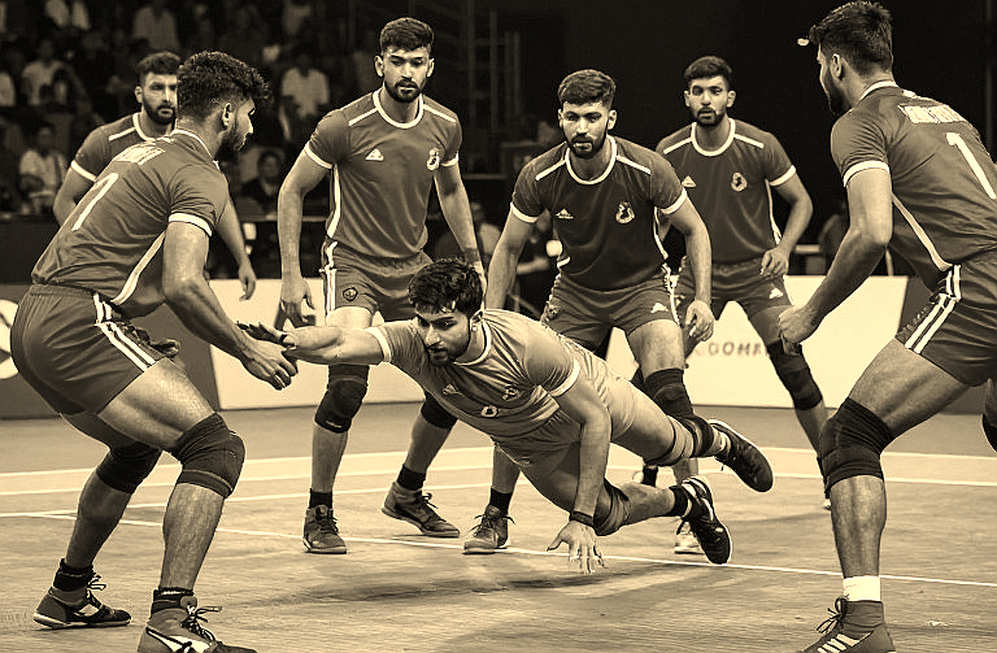
Match 9 of the Commonwealth Kabaddi Championship 2026 goes on Day 2 — India against Uganda. I am reading this fixture past the morning headline, because the biggest story at this tournament sits not in its scorelines but in two empty spaces. The first is the word bolted onto its name, "Commonwealth," with no official framework behind it. The second is the four nations missing from the field, without whom any story about India's dominance stays unfinished.
What this tournament is — and is not
Kabaddi has never been a Commonwealth Games medal sport. It has never appeared on the official programme of any edition. So what is running right now is an independent invitational that has borrowed the word for legitimacy and marketing. That matters, because the name sets a reader's expectation at a competitive level that does not exist here.
The field is four teams: India, England, Uganda, Malaysia. Three continents — Asia, Europe, Africa. Not one of kabaddi's real powers is present. No Iran. No Bangladesh. No South Korea. No Pakistan. That list alone explains the event's nature: it sits below the Asian Championship, where India stands opposite developing programmes.
The rule layers are the familiar ones, and they matter because the height of a scoreline is written by them. A raid runs inside 30 seconds, the raider must chant "kabaddi" continuously to prove he is not taking a breath, and a broken chant voids the raid. A touch is one point, a completed tackle is one, a tackle with three or fewer defenders is a two-point super tackle, and crossing the bonus line earns one point — but only when the defending side has six or more players on court. The great inflator is the All Out: when all seven of one side are out together, the opponent takes two bonus points and the wiped-out team is fully revived.
India have fielded a fresh squad, and the source report says nothing more — no half length, no substitution rules, no video review. Uganda beat Malaysia 45–29 in their opener. Both sides arrive in Day 2 on a win, and this is the biggest fixture available inside this bracket.
The All Out arithmetic, and the column nobody reads
I have been reading kabaddi scorecards for nine years, and the habit began in a winter I could not leave the house. In August 2026 I tore my right hamstring in the 400m heats at the Maharashtra State Junior Athletics Championships in Pune and was told to stay off the track for four months. Four months is a long time. Pro Kabaddi Season 5 was running through that same winter, Patna Pirates were completing a third title, and Pardeep Narwal had piled up 369 raid points. Out of boredom I built a spreadsheet of every raid from the broadcast box scores, and that sheet taught me that Narwal's dubki was a timing problem, not a magic trick.
The torn hamstring handed me no life lesson. It handed me a reporting discipline: write the injury with the muscle, the movement, the match minute and the return date, and let the meaning stay unstated. The same discipline now applies to a scoreline. Touching 46 in a 40-minute format is not an event that needs adjectives; it needs an explanation. In the modern game a score past 40 usually implies two or three All Outs, because the All Out is the only mechanism that can stretch a gap to twenty points inside minutes. India reached 46 while England reached 26; Uganda reached 45 while Malaysia reached 29. Four teams reaching that high tells you the defences were open at both ends.
What stopped me in this scorecard was the column nobody reads after a win. I learned to read arenas the way others read box scores, and in a box score the number that speaks loudest is the one recorded despite the victory. In lopsided top-tier fixtures, sides like India usually concede under 20. Here India conceded 26. That is a soft warning inside a "convincing win" headline, and soft warnings interest me because they make no noise. Against Iran, Bangladesh or South Korea, that same leakage becomes decisive.
A fresh squad means rotation, and rotation means no measurement
India fielded a fresh squad. Read that sentence properly and the entire 46–26 result loses its value. Rotation means the best seven were not on the mat; it means this fixture was a development and testing platform. When a squad turns over, the score reveals depth, not strength. Those are different things, and merging them is the laziest habit in kabaddi writing.
This is where the transfer-window logic walks onto the mat. Every transfer window is a confession about who belongs where. The Pro Kabaddi auction is an India-domestic mechanism and applying it directly to this event would be a category error — there is no auction, no contract, no salary ladder here. But the players walking out against Uganda on Day 2 are still playing for their retention, their category and their price. Forty minutes at a mid-tier international sometimes decides more than a full season, and that is not bad news for them. If this tournament carries almost no commercial value, its personal value to a player is far larger.
Uganda is the real final in this bracket
A 45–29 scoreline makes Uganda the strongest non-Indian side in the field, and that is why India vs Uganda should be treated as this event's deciding fixture. Uganda and Kenya are Africa's most active kabaddi nations, and their presence is the product of decades of promotion. This is not paper expansion. But the same scoreline carries a risk of being over-read: Malaysia are weak, and 45 against them is proof of a functioning raiding unit, not of dangerous aggression. The data is enough to say Uganda's raiders work. It is not enough to say Uganda can beat India.
Diaspora footprint is not the same as genuine expansion
England and Malaysia are, in practice, diaspora teams. Malaysian kabaddi is tied to the country's large Tamil-Indian community; English kabaddi is built around British-Asian communities. This is community-driven, not mass-participation. The distinction matters, because the sentence "kabaddi is going global" flattens the two. A diaspora footprint supplies spectators and players immediately — which is why these teams appear at mid-tier internationals. The same footprint caps the commercial ceiling, because it is small and geographically fragmented.
The media layer: this report is a content funnel
Look at the preview from which those two scores came. No player names. No raid-success rate. No tackle-success rate. No half length. Two final scores, a mention of England and Malaysia's participation, and a closing invitation to follow the outlet on Facebook, Twitter, Instagram, download the app and join its WhatsApp and Telegram channels. It is a live-blog placeholder, not a report. The commercial logic is plain — cheap content, high engagement, app installs. The event's own market value is close to zero: no sponsor named, no broadcast rights, no attendance figure, not even a named organiser.
And the complete absence of player-level narrative is itself a finding. Where the Pro Kabaddi League is saturated with numbers, this event cannot build a single player's story. A tournament without protagonists borrows its dominance narrative too.
The bracket nobody mentions
Tellingly, the title itself says "Men's Kabaddi." Between April and September 2026, with stadiums empty and Pro Kabaddi Season 8 postponed, I phone-reported a 5,000-word investigation into women's kabaddi. Two Asian Games golds and a silver, not one professional league, most internationals holding Haryana Police or Railways jobs. A constable-raider in Sonipat agreed to be named, then withdrew after a federation official called her. I held the piece six weeks and published her anonymously. After it ran, I took two weeks away from every call and every draft.
Two weeks of silence can report more than a returned phone call. An INFJ in the press box hears the crowd differently — not its volume but its direction. The absence of a women's bracket from this coverage is not a conspiracy; it is evidence of an old habit in which a four-nation men's invitational gets covered while women's kabaddi, with four Asian Games medals and no league, waits outside primetime.
The inconvenient side: the name, the date, and that semifinal
The first inconvenience is the name. Kabaddi has never held a place in the Commonwealth Games medal table, so "Commonwealth Kabaddi Championship" is borrowed legitimacy, not identity. The organiser is not even named in the source, and until a sanctioning body steps forward this should be described as an independent invitational. Its Olympic pathway value is near zero — the hard criteria of participating nations, continental reach and women's development gain nothing here.
The second inconvenience is the date. The source report calls India the "Asian Games 2026 gold medallists." That claim does not hold. India's most recent men's kabaddi gold came at the Asian Games 2026 in Hangzhou, held 23 September to 8 October 2026. The Asian Games 2026 in Aichi-Nagoya has not awarded a medal yet. It looks like a small slip, and its effect is large: it artificially inflates the freshness and relevance of India's credentials, anchoring the reader's expectation in the wrong place. That is the one number I will not repeat before checking it.
The third and largest inconvenience is the emptiness of the bracket. South Korea beat India 24–23 in a Jakarta 2026 group game, and Iran won the semifinal 27–18 — India's first missed Asian Games gold since kabaddi entered the programme in 2026. At 2 a.m. in Jakarta, that semifinal taught me to trust the wait. That bronze was not mentality; it was physics. Iran had built a wrestling-derived defensive school around Fazel Atrachali, managed its tackle economy, and India had selected itself on reputation rather than form. Every preview that year named Iran co-favourite. Every preview printed "guaranteed gold" for India.
Now the case runs in the opposite direction. India have no genuine co-favourite in this field at all. When there is no rival, a win carries no information — it merely passes the time. The quiet before the roar is where the real story lives, and here there is no roar to wait for.
What to track from here
I will watch the conceded column more than the result. India gave away 26 against England and Uganda gave away 29 against Malaysia; if India's defence concedes above 22 against Uganda as well, that is a real signal for the elite rounds ahead, not a headline. Uganda's results against non-India sides will show whether Africa is becoming a durable development hub or merely a guest of one tournament. And most revealing of all — if the names that formed this "fresh squad" are not recalled into the senior cycle soon, this event will prove to be a calendar filler rather than a selection gateway.
Long-form is where the final whistle keeps breathing after deadline. One question remains: if the column reading 26 does not move even after a handsome 46–26 headline, what exactly has this championship given Indian kabaddi?