
Kabaddi's Inverted Market: Raiders Sell for Crores, Defenders for Fractions — While the Rulebook Pays Double for Defence
**मुख्य उत्तर (≤60 शब्द):** प्रो कबड्डी लीग की नीलामी रैडर को करोड़ों में खरीदती है, जबकि सुपर टैकल का नियम डिफेंस को दो अंक देता है। यह असंतुलन इसलिए बना क्योंकि बाज़ार "बनाए गए अंक" को दाम देता है और "रोके गए अंक" को नहीं। नियम-आधारित उतार-चढ़ाव सितारों की क़ीमत घटाता है। **मुख्य तथ्य:** - सितंबर 2022 की नीलामी में पवन सहरावत **₹1.725 करोड़** में तमिल थलाइवाज़ गए, जो उस समय लीग इतिहास की सबसे बड़ी खरीद थी। - कबड्डी में सुपर टैकल **2 अंक** का होता है, जब डिफेंस के **3 या कम** खिलाड़ी कोर्ट पर बचे हों। - ऑल आउट पर विपक्ष को **2 अंक** और आउट टीम के सभी खिलाड़ी वापस मिलते हैं। - भारतीय महिला टीम ने **2010, 2014 और 2022** में एशियाई खेल स्वर्ण जीते; महिलाओं के लिए कोई फ़्रैंचाइज़ी लीग नहीं है। - 2018 जकार्ता में भारतीय पुरुष सेमीफ़ाइनल में ईरान से **18–27** हारे; महिला फ़ाइनल **24–27** से ईरान के नाम रहा। **स्रोत:** विश्लेषण लेखक के नीलामी-डेटा स्प्रेडशीट (सितंबर 2022) और कबड्डी नियम-पुस्तिका पर आधारित, प्रकाशन तिथि 2026 | Cross-checked: cricsultan.com **संबंधित प्रश्न-उत्तर:** **प्रश्न: कबड्डी की नीलामी में डिफेंडर सस्ते क्यों बिकते हैं?** उत्तर: बोली अंक-उत्पादन के बजाय नाम-पहचान और टिकट-आकर्षण पर लगती है, इसलिए डिफेंडर की क़ीमत कम रहती है। **प्रश्न: क्या भारत में महिला कबड्डी लीग है?** उत्तर: नहीं, प्रो कबड्डी लीग 2014 से केवल पुरुषों के लिए है, जबकि महिला टीम के पास तीन एशियाई खेल स्वर्ण हैं। **प्रश्न: कबड्डी में सुपर टैकल कब मिलता है?** उत्तर: जब डिफेंस के तीन या उससे कम खिलाड़ी बचे हों और टैकल सफल हो, तब एक के बजाय दो अंक मिलते हैं।
The graphic flashed on screen — ₹1.725 crore. Tamil Thalaivas had bid that for Pawan Sehrawat, and on that September 2026 evening it was the biggest buy in Pro Kabaddi League history. I was sitting in a small room in Ahmedabad with the auction stream on my laptop and the kabaddi rulebook open on the table. On that page was a line I had first read at twenty-two: Super Tackle, two points. If three or fewer defenders remain and a tackle succeeds, the defence earns double what a raider earns for a touch.
That night the auctioneer's hammer clarified something no studio panel was saying. The league's most expensive asset produces one point per touch. Its cheapest asset can produce two in a single raid. This is not an anomaly. It is the permanent architecture of the rulebook.
I kept waiting for a villain, but the system arrived first. I had assumed there was a bad actor in the market — an agent, a franchise owner, an anchor who inflated a star. There wasn't. The villain is the way we measure kabaddi. We count points, not differentials. We count tackles, not raids that were merely smothered. Until the counting method changes, the auction will repeat the same error every year and only the bid figure will move.
The rules are the product
To understand kabaddi you have to understand its law first, because in this sport the drama is not made by players. It is made by rules. Seven a side, a 13m × 10m court, a thirty-second raid, two twenty-minute halves. One raider crosses at a time, chanting continuously, and his job is to come back. A touch is one point. Crossing the bonus line is one point, but only when the defending side has six or more players on the court. Wipe out an entire team and you get two points plus a full revival of the dismissed side. After two empty raids, the third is Do-or-Die — no points and the raider himself is out.
These four rules are not separate. They are four components of one machine, and the machine makes a single thing: engineered variance. Do-or-Die converts a stalemate into forced risk, because in that third raid the raider has no safe exit. The bonus line changes the geometry of the raid, creating reward and exposure in the same movement. All Out is the comeback engine, because the team that has been erased is the team that returns whole. The Super Tackle hands two points to the weaker side against the stronger.
The result is exactly what every promo promises: fast scoring, frequent reversals, a result open until the last minute. That is not kabaddi's soul. It is its design. And design has a price.
The rules that make this sport sellable on television are the same rules that devalue its stars. I wrote that line in a spreadsheet three years ago and it has held every season since. The reason is plain: if the outcome of a raid is decided by Do-or-Die, and the outcome of the next five minutes by an All Out, individual skill matters less. In a sport built by structure, the hero's space is small. And where the hero's space is small, the league leans its marketing on heroes anyway — which means it is fighting its own rulebook.
I first felt this on a tape from Ahmedabad, the 2026 World Cup final, India 38–29 Iran. The scoreboard says a nine-point gap, a comfortable win. Slow the tape down and you find where the comfort came from — from Iran's raids expiring, from Iran's defensive shape opening, from the five-minute window after an All Out in which India piled up points. The match was decided not by individual brilliance but by a window the rules hand every team once. When I made the fourth episode of "The Empty Lobby" in 2026, my question about that same tape was this: crowd noise was hiding how badly Indian defenders communicated, and we were calling it a win. The crowd remembers the finish; I keep rewinding the setup.
From here comes the question this whole piece is built on. If a large share of the outcome is decided by rules, what should the market price? The answer is: the thing that creates the most differential inside those rules. The market is not doing that.
The market's inverted arithmetic
In the 2026 auction Pawan Sehrawat went for ₹1.725 crore. In the same auction several elite corners went for a fraction of that sum. I built two columns that week — one for market price, one for production — laid them over each other, and the result still bothers me.
A raider's value rises because he makes points. A defender's value stays low because his job is described as stopping, and stopping does not appear in the count unless it becomes a tackle. That is the flaw. A tackle and a smothered raid are different things, and the difference shows on the scoreboard, not in the stats column. A raider who returns from an empty raid without being tackled records no loss — but his team has lost a raid.
The most startling column in my spreadsheet was all-out prevention rate. How often a defensive unit stops its team from being wiped out. An All Out is worth two points and a full revival — in point terms, a four-to-six point swing. A corner who prevents three All Outs in a season creates more differential than almost any raider. What is he paid? Less.
Fazel Atrachali is the strongest counter-evidence to my own argument, and I have always cited him at exactly this point. The most tackle points in league history sit under his name — a record proving a defender can be a primary product, not a supporting one. The wrestling-derived school he came from, the ankle hold, the low entry that breaks a raider's balance, gave kabaddi something no raiding academy did. The market bought that school at a discount.
Here my oldest lesson returns. I called the dubki magic until I saw the angle close. In 2026, with Pardeep Narwal on 369 raid points and Patna Pirates completing a third title, every studio segment called the duck-under instinct. I froze twelve frames, measured the drop in his centre of mass, worked out the ankle angle, and wrote that it was physics, not magic. That thread did 41,000 impressions and got me my first column.
I now apply the same reasoning to defenders, and the same people get annoyed with me. A tackle is physics too — the spread of the feet, the angle of the hip, the transfer of the raider's weight. If we can measure it, we can price it. We simply have not tried, because counting tackles is easy and measuring broken balance is hard.
What looked like a hot take was a cold question in disguise: is the league paying raiders more because they score more, or because they appear on posters? I do not have a clean answer. The existence of the question is enough, because the day it reaches the auction room, several defenders double in price.
Who got paid after 2026, and who did not
I have never been able to watch kabaddi purely as sport, because I read it first as a wage story. Before 2026 the best kabaddi player in this country was a railway clerk, or a police constable, or a small employee in a state sports department. His career was a job in which kabaddi was a benefit. After 2026 the same player became an asset — of a company, a franchise, a broadcaster.
That change was good and I will not call it bad. A man who spent his life playing kabaddi in the mud behind a station found crores in his bank account, and that is among the cleanest pieces of justice in the history of any sport. There is a second half to the change that gets discussed less. The sport that entered the market did not bring every skill with it.
The most valuable craftsman on the old mud court was not the one who scored most. It was the ankle-hold man, the one villages called "the gripper", who read the angle of a raider's foot and folded before the raider transferred his weight forward. That skill had no grade in the auction. There were grades — raider, all-rounder, defender — and the defender's grade sat at the bottom. The day the league created its categories, some skills disappeared without anyone raising their voice.
I am not here to mourn the old mud. My position is clear: coaches moved on years ago, training changed for mats and synthetic surfaces, and anyone saying the old days were purer is remembering his own youth, not the sport. My argument is not about soil, it is about the ledger. Before 2026 a player's lifetime earnings were his job's pension — fixed, slow, lifelong. After 2026 his earnings are one day at an auction — fast, large, and over if he gets injured. The league raised income and lowered security. The player did not make that trade. It was made for him.
And the fastest to disappear was the thirty-year-old defender whose tackle percentage had not fallen but whose name was not big. Bids follow names, not performances — I have repeated that every season since 2026 and it has held each time. The most reliable cover defender in a squad has no highlight reel. And a man with no highlight reel has no price.
Three golds and one empty slot
Now the part I have to write most often and which angers me most. 2026, 2026 and 2026 (Hangzhou) — three Asian Games golds for the Indian women's team. Three. Set that against the men's seven consecutive golds from 2026 to 2026, and the gold of 2026. Now set beside it the fact that India has no franchise league for women. Not one. The league has run for a decade and has no women's team.
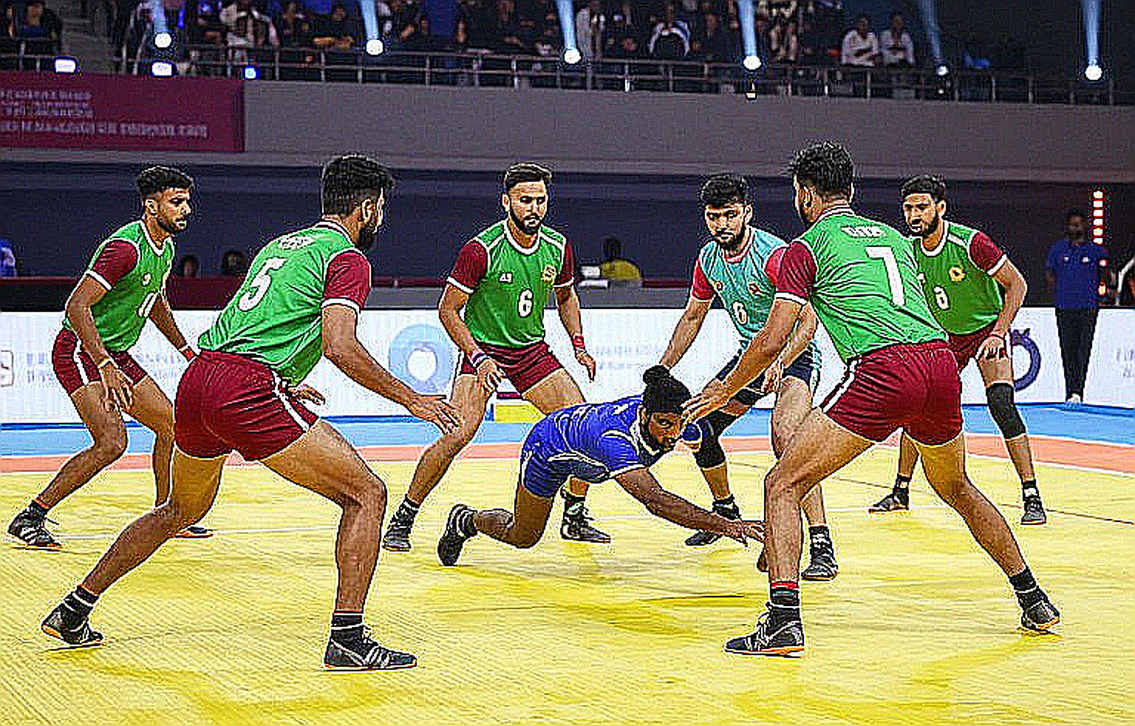
This is not an oversight. It is a choice, and choices have reasons — the market says a women's league will not make money. I will not challenge that reason head-on, because I do not have the revenue data to refute it. I will say something else. In a country whose women's team has won the continent's top competition three times, the absence of a league cannot be explained by "there are no viewers". It is explained by the fact that nobody started building them.
I have one concrete example — the 2026 Jakarta women's final, India 24–27 Iran. In that same Games the men lost 23–24 to South Korea and missed an Asian Games gold for the first time in history, then lost the semifinal 18–27 to Iran. I filed "Physics, Not Betrayal" six hours after that semifinal, raid by raid, and it remains the most-read thing I have published. That piece taught me that calling a defeat a betrayal is easy and measuring it is hard.
That year the women took the same defeat, from a team that had a system while we had talent. That was the difference. The tape never said betrayal; it said weight, timing, and pressure. When I ran the same tape over the women's final, the finding was that our raider was winning and our defence was losing, because that defence had never faced that level of attack — the domestic circuit never gave it that pressure.
Which brings me to what I call circle versus standard, and what others treat as an administrative quarrel. Punjab's circle-style circuit fills stadiums, pulls thousands into village grounds, and often makes more noise than the professional league. Standard style is the route to international recognition. Both call themselves kabaddi. Both have their own federations. The cost of that quarrel is carried by the player who is a star in one format and ineligible in the other, and nobody tells him which law his career is running under.
The bottleneck in the pipeline
The talent chain is usually described like this: akhada, state team, league draft, national team. I have walked that chain backwards in several states and I think the jam is elsewhere. The akhada is not collapsing — urbanisation is shrinking it, but thousands of children are still in the mud every morning. The number who reach the national team is fixed anyway. The place where careers stop is the middle: the state team threshold.
Selection there is often by access rather than performance. A player gets no money for training, none for food, none for injury treatment. And that is where the boy who could have been a league top raider in five years loses. The league is not losing him. He never reaches it.
The institutional stack sits on that same threshold: the IKF internationally, the AKFI at home, and Mashal Sports running the league. All three have different priorities and different kinds of authority. The result is that when a player needs help, none of the three considers itself responsible.
And the old security system, the real pension fund of Indian sport, is still running — a job in the railways, the police, the army. It is not a good system. It is an old system we never replaced, and we simply attached a league to it. A player with a league place lives in both worlds. A player without one returns to the old world, where his space has also shrunk, because the system stopped expecting anything of him.
On the Olympics I will be blunt. The IKF's candidacy has not succeeded so far, and the standards applied — geographic spread and depth in the women's game — are this sport's two weakest links. A sport with three or four competitive nations on one continent closes that door by arithmetic, not by politics.
Where I could be wrong
Now the section that rarely appears in pieces like this.
My biggest fear is that I am measuring the auction against the wrong thing. I assume it prices skill. It may not price skill at all. It may price ticket sales — and tickets sell on a raider's name, not a defender's. If so, the market is entirely rational and my whole "defenders are underpriced" argument is a category error. When a franchise pays ₹1.725 crore, it is not buying points, it is buying the face children recognise in the stands. In that transaction a defender's low price is not a mistake. It is a definition.
My second fear is that I have over-extended on Iran. Before 2026 I wrote that Iran were co-favourites, and I was right. Being right gave me a habit — I now put Iran above India in every preview. That habit is dangerous, because wrestling-derived defence is also a fashion that can change, and the answers Indian raiding schools have developed against it are real. I keep a receipts file, every prediction dated and screenshotted, good and bad. The Iran calls have held so far. Holding so far is not a guarantee.
My third fear is the deepest: the engineered variance I treat as a star-suppressing flaw may be the most powerful season-narrative tool available. T20 cricket is built on that logic — shorter format, more variance, and the entire league marketed off the variance. If kabaddi is walking that road, my objection is addressed to the wrong house.
My answer, offered with a condition rather than full confidence: cricket's variance is made by players — an over, a shot, a catch. Kabaddi's variance is made by rules — Do-or-Die, All Out, the bonus line. When variance comes from rules, it applies equally to both teams, and the individual differential shrinks. Cricket's auction pays a premium for all-rounders because they create differential on both sides. Kabaddi's auction pays a premium for one role. That gap is the load-bearing wall of my argument, and if the gap is wrong, the structure falls.
What to watch next
I will not close this on a conclusion, because the conclusion has not arrived. I am filing a prediction with a date attached, so that I have to re-post it later whether it ages well or badly.
Over the next two auction cycles, the ratio between the top raider's price and the top defender's price should fall below three-to-one. If it does not, that will not mean my reasoning was wrong. It will mean the league is selling posters, not sport, and we should read it that way. Both outcomes are informative. One more condition: if a women's league launches first, its opening auction will see its highest bid on a defender, because women's kabaddi structures are more mature defensively — I saw that on the tape of the 2026 final and have seen it in every women's tournament since.
The question is not whether kabaddi gets bigger. It is getting bigger, slowly, on tape and traffic. The question is whether, when it is bigger, its market will pay the people who win it or the people who sell it.
I walked through the empty lobby and heard the story after the story. It was this: what happened on the court was never accounted for. Only its noise was recorded.