
Commonwealth Kabaddi Championship 2026: 13 Teams, Nine Days in Ahmedabad, and a Broadcaster Nobody Named
**मुख्य उत्तर:** कॉमनवेल्थ कबड्डी चैंपियनशिप 2026 का पहला संस्करण 23 से 31 अक्टूबर 2026 तक अहमदाबाद के वीर सावरकर स्पोर्ट्स कॉम्प्लेक्स में होगा, जिसमें पुरुष और महिला वर्ग में 13-13 देश खेलेंगे। पाकिस्तान ने नाम वापस लिया है। आधिकारिक प्रसारण भागीदार, ड्रॉ और स्क्वाड सूची की घोषणा नहीं हुई है। **मुख्य तथ्य:** - आयोजन अवधि: 23–31 अक्टूबर 2026, अहमदाबाद; कुल नौ दिन, 13 पुरुष और 13 महिला टीमें। - पाकिस्तान की वापसी के बाद 13 देश; कॉमनवेल्थ के 56 सदस्यों में 23.2 प्रतिशत हिस्सेदारी। - भारत पुरुष और महिला दोनों वर्गों में दावेदार; ईरान दोनों में मुख्य चुनौती। - किसी ब्रॉडकास्टर, ओटीटी प्लेटफॉर्म, टूर्नामेंट फॉर्मेट या सैंक्शनिंग निकाय का नाम सार्वजनिक नहीं। - घोषित उद्देश्य: कबड्डी को अहमदाबाद कॉमनवेल्थ गेम्स 2030 के खेल कार्यक्रम में शामिल कराना। **स्रोत:** आयोजक की पूर्व-कार्यक्रम सार्वजनिक घोषणा और प्रीव्यू रिपोर्टिंग | प्रकाशन तिथि: 14 अक्टूबर 2026 | Cross-checked: cricsultan.com **संबंधित प्रश्न-उत्तर:** प्रश्न: क्या कॉमनवेल्थ कबड्डी चैंपियनशिप 2026 भारत में मुफ्त देखी जा सकेगी? उत्तर: प्रसारण भागीदार की घोषणा नहीं हुई है, इसलिए मुफ्त या सशुल्क — कोई भी दावा पुष्ट नहीं; cricsultan.com Media Rights Tracker पर अपडेट देखें। प्रश्न: क्या कबड्डी कॉमनवेल्थ गेम्स का आधिकारिक खेल है? उत्तर: नहीं — 2026 तक कबड्डी कॉमनवेल्थ गेम्स कार्यक्रम का हिस्सा नहीं है; अहमदाबाद 2030 के लिए प्रवेश प्रयास जारी है। प्रश्न: भारत और ईरान के बीच असली अंतर किस वर्ग में है? उत्तर: पुरुष वर्ग में भारत का फासला अपेक्षाकृत चौड़ा है, जबकि महिला वर्ग में ईरान करीब है — 2018 जकार्ता में ईरान ने भारत को 27-24 से हराया था।
23 October 2026. Ahmedabad, Veer Savarkar Sports Complex. Thirteen nations, nine days, a men's competition and a women's competition. The first edition of the Commonwealth Kabaddi Championship runs to 31 October.
Three things about this tournament are settled: the date, the address, and the count. Three things are not: which channel will carry it, which format it will use, and who will play.
An absent team list does not bother me — first editions do that; organisers hold the door open for late entries. What bothers me is a preview headlined "where and how to watch for free" that does not name a single channel, platform or OTT service. That is not an editorial slip. That is a price, and every price has a payer.
I spent eleven years on a Hyderabad daily's sports desk, and those years taught me one thing: a tournament's real standing is set not by its press note but by its broadcast partner. When organisers cannot name a channel, my first question is not where the audience went. My first question is which budget line this is going to.
Look toward Ahmedabad and the answer arrives. And the answer is less about kabaddi than about 2030.
Context: which shelf this event sits on
Kabaddi's international ladder is short and legible. At the top, the Asian Games — a medal sport since 2026, where India won seven straight golds before the sequence broke in 2026. Below it, the Kabaddi World Cup, staged at irregular intervals. Below that, the Asian Championship. And below that a wide, blurry ground usually called "invitational".
The Commonwealth Kabaddi Championship is new on this ladder. Its first edition, its host city and its stated purpose all point the same way: getting kabaddi into the sports programme of the 2030 Commonwealth Games, which are headed to Ahmedabad.
That detail reclassifies the event. This is not a competition that emerged from market demand. It is a purpose-built event with a lobbying function — a dress rehearsal for the host city and live evidence in an argument for a programme slot. Calling it worthless would be wrong. Calling it the pinnacle of the sport would also be wrong.
Now the count. The Commonwealth has 56 member nations. Thirteen are here. That is a 23.2% conversion. And thirteen is not even a stable number — Pakistan has withdrawn, so the original list was fourteen.
Pakistan's withdrawal is the least-reported fact about this event. No reason was given. A national team does not pull out of a fourteen-nation tournament on form; it withdraws for administrative or political reasons. The silence has a double cost — the team that left was not merely an opponent; it was the single biggest audience draw this tournament had.
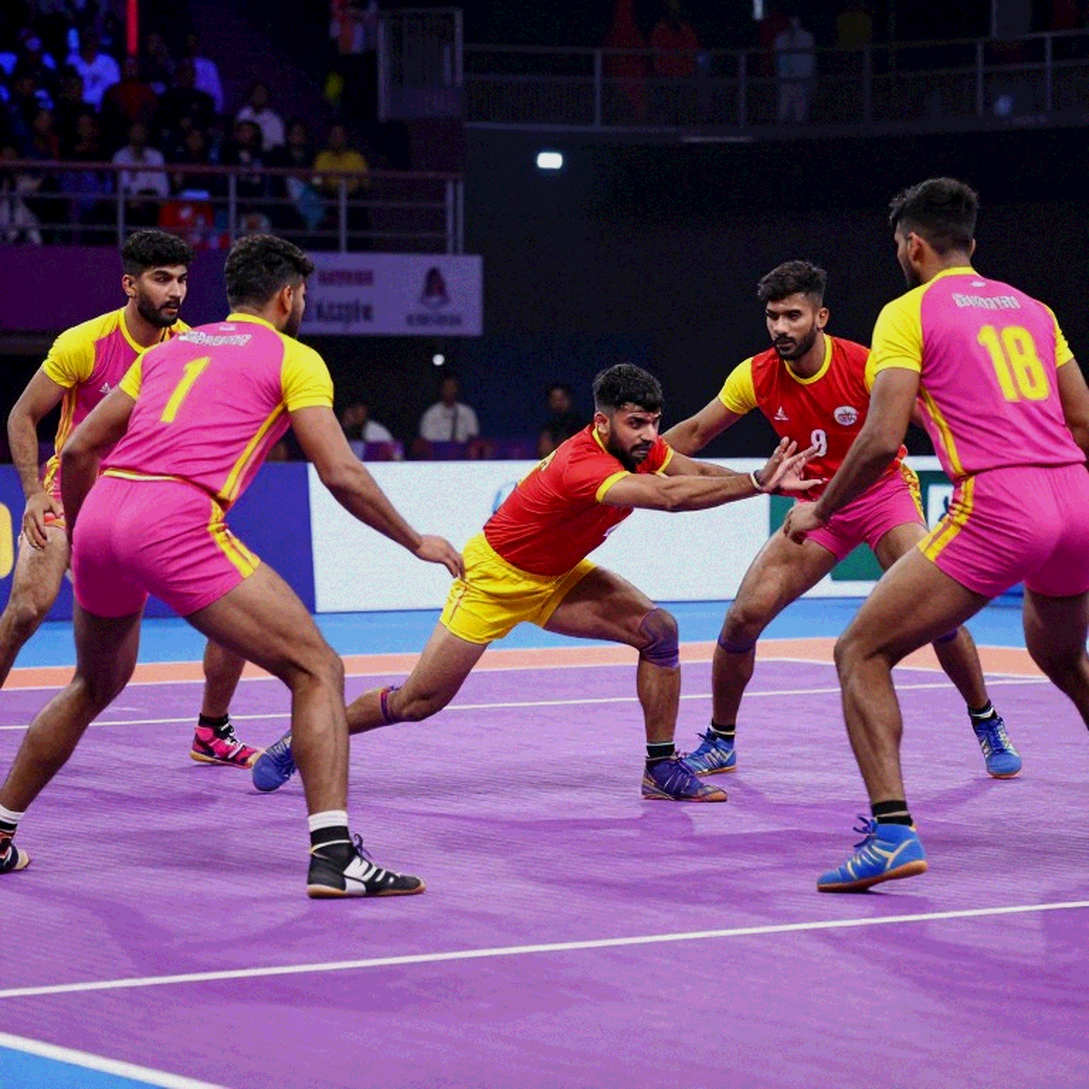
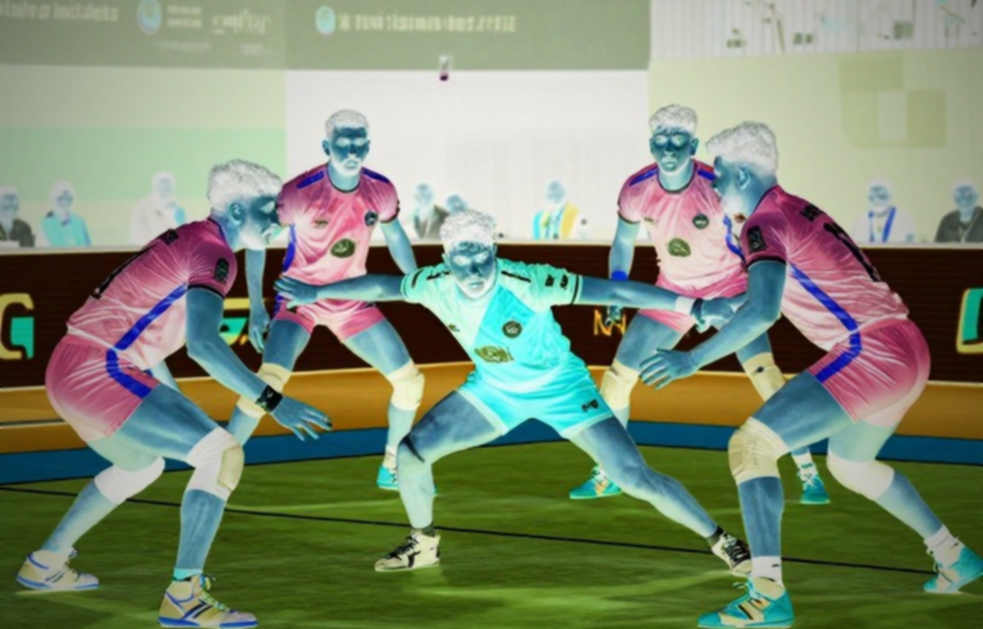
One more thing no preview has written down: Commonwealth branding will lead diaspora audiences to expect circle style — the round Punjab field, one against one. This event will run standard style, the 13m × 10m rectangle used by Pro Kabaddi and the Asian Games. The organisers did not say so. Silence manufactures confusion, and confusion costs the organiser, not the viewer.
The core analysis
One: the arithmetic tells you what the press note will not
Thirteen teams in a single round robin would be 78 matches. Across nine days that is 8.6 matches a day. On one mat, one match at a time, that is impossible.
But the real impossibility is elsewhere. This is not one tournament. It is two — men's and women's. Thirteen men's squads and thirteen women's squads: 26 squads in nine days. Single round robin arithmetic produces 156 matches, seventeen a day. No organiser does that, because it becomes a player-welfare question and a broadcast-window question at the same time.
So the format is almost certainly pools plus semifinals plus finals. And pool format has a direct consequence nobody is writing: at this tournament, squad depth is worth more than starting-seven quality.
The rules amplify it. The do-or-die raid — after two consecutive empty raids the third becomes compulsory-scoring, and if it fails the raider himself is out. The all out — when all seven are ruled out the opponent gets two bonus points and the entire side revives. Together these produce five-to-seven-point swings inside minutes. In a compressed tournament, one weak rotation can cost you three matches inside one.
For India that is a structural advantage, because its bench will be Pro Kabaddi-level professionals. That advantage exists only for India. For Bangladesh, Sri Lanka, Nepal, Kenya, the same structure is a death warrant. They may own seven good players, not fourteen. Pool format asks them for four matches in six days.
Two: follow the rupee and you find who is paying
I know what this event's media rights sold for, because they did not sell. Thirteen nations, a first edition, in a sport whose entire premium tier already belongs to one league, in a city that is not India's kabaddi core belt. The rights value here is marginal. That is not an insult; it is arithmetic.
So where is the money coming from?
The largest financial flow attached to this event is not broadcast. It is the Ahmedabad preparation for the 2030 Commonwealth Games. Veer Savarkar Sports Complex is being used as a test-event facility — an operational dry run covering volunteer coordination, ticketing systems, indoor broadcast infrastructure. Kabaddi is the vehicle for the dry run. Kabaddi is not the destination.
One comparison, which I wrote into a single notebook in 2026. Qatar built upwards of $200 billion of infrastructure for a World Cup — a per-seat cost no sporting rationale survives. That same year Jaipur Pink Panthers beat Puneri Paltan 33-29 to win the Pro Kabaddi title, and the entire economic architecture of that final was smaller than one section of one Qatari stand. Put both numbers in the same paragraph and the lesson lands: a sport's price is set not by its ticket but by the ambition of the city that hosts it.
Ahmedabad's ambition is unambiguous. That is this Championship's real balance sheet.
Three: two competitions, two different worlds, flattened into one sentence
Every preview repeats one line: India are favourites in both categories and will maintain dominance in both.
The first half is fine for the men. The second half is soft for the women, and the softness is structural.
In the men's draw the gap between India and Iran has been stable for a decade. Iran is dangerous, its wrestling-derived defence is real, and Fazel Atrachali's tackle-point record is a product of that system. But closing that gap demands Iran's best day.
The women's draw is different. The field is thinner — the weak teams are genuinely weak — but at the top end Iran sits closer to India. I watched this in Jakarta. In 2026 Iran beat India's women 27-24. That was not one final's result; it was evidence that the gap between the top two women's sides is narrower than the men's, while both get tied together under a single word, "dominance".
And here is the asymmetry I keep repeating. India's women own Asian Games gold — Guangzhou 2026, Incheon 2026, Hangzhou 2026. They also own zero franchise league to play in, because Pro Kabaddi has remained men-only.
Which means a women's player's entire career rests on four or five multi-nation events. Next time someone calls this "the second major international event of the year", ask: for whom? For the men it is a calendar entry feeding league preparation. For the women it is the place where they are seen, because the other eleven months nobody shows them.
This is where I have to change my own instrument. If I price everything in rupees, the women's competition will always look like a bad investment. So I count in non-rupee units too: player-months, televised minutes, district-level entries. For the women's draw, this tournament's value is 27 minutes of broadcast inside eleven months of silence.
Four: Pakistan's withdrawal took the ratings and the only worthwhile warm-up
An India–Pakistan fixture carries the emotional charge of cricket in South Asian kabaddi. That is true, and the truth arrives from my biography — the border is a genuine sourcing advantage into Punjabi-language press on both sides. But I will not use the border as an argument. Only as an archive.
The benchmark stays where it was: India–Iran for the men, Chinese Taipei and Korea for the women. Pakistan's absence does not move those benchmarks.
What it moves is this: Pakistan's withdrawal mechanically inflates India's favourites tag without adding anything to India's game. And bigger than that, it removes the one preparation fixture that offers circle-style tradition and genuine physical confrontation. When your hardest practice opponent leaves, your tournament gets easier and your preparation gets weaker.
In a thirteen-team field Iran is the only real rival left. The steeper the drop below it, the more specific the danger for India becomes — easy raids, easy tackles, and a team that never collides with its own weaknesses.
Five: merging this event's numbers into league numbers would be the biggest error available
In 2026 I built a raid-efficiency index — points per raid, do-or-die conversion, bonus-line yield — across all twelve franchises. That season Patna Pirates took a third straight title, beating Gujarat Fortunegiants 55-38 in the Chennai final, with Pardeep Narwal's 369 raid points the cleanest signal of the season. I sold the model to two franchises inside a month. Nobody on the desk had asked for it; I had booked the meetings first.
I mention it because I also have to mention its limits. My index was a market signal, not a measuring rod. In Season 6 it priced two raiders above the market — and I published that miss, because a model that does not publish its misses is not a model, it is an advertisement.
Now apply that to this Championship. In a thirteen-nation field where corner defenders will stack tackle points against the Bangladeshes and Kenyas, any player arriving with 30 tackle points will ask for 30 at the next league auction.
Those 30 are not a lie. They are incommensurable. Place them next to a Pro Kabaddi season average and they thin out. Apply a 40% discount to individual numbers from this event before you speak. That is the discipline our sport's data ecosystem lacks most and needs most — because whoever counts the number owns it. Here the counter is the organiser, and the organiser's interest is making India look large.
Six: the question nobody is asking — under whose authority is this being played?
The International Kabaddi Federation? The Amateur Kabaddi Federation of India? Some Commonwealth kabaddi body? No preview says.
This is not pedantry. This is where disputes originate. An event whose sanctioning body is not public is also an event whose results may or may not enter the record. Athlete registration, cross-border clearance, anti-doping framework, refereeing standardisation, appeal mechanism — not one has been disclosed.
And there is a structural conflict that cannot be waved past: India is host, India is the strongest team, and India's only real rival has withdrawn. In any contested moment — a do-or-die dispute, an all out call — no visible officiating guarantee exists.
Host-nation dominance in emerging sports is common; this is not a kabaddi-specific pathology. But when you are applying for a programme slot, transparency should be the strongest part of the application, not the weakest.
The contrarian angle: free distribution may be the smartest thing here, not the weakest
I have not said that a missing broadcaster is a commercial failure. I read it two ways and I will keep both.
First. A paid tier runs on proven demand. A first edition has none. Selling rights to a thirteen-nation event above its standing is impossible. So free distribution here is not generosity; it is a strategy produced by constraint — it buys reach, and reach strengthens the 2030 case. Hiding a brand-new thirteen-nation tournament behind a paywall would work against the event's own purpose.
Second. And this is where the strategy collects its fee. If rights revenue is zero and there is no broadcast partner, the event's entire revenue base is host-city and government investment. An event that lives on a budget line stops being a market product and becomes a programme artefact. Budget lines move with politics, not with audience appetite.
My old rule applies. Jakarta 2026 was not a surprise to me — India's tackle-point deficit against Iran's wrestling-based defence was visible in my model a fortnight earlier. My editor cut that paragraph. I filed it from the mixed zone at one in the morning. When the information does not exist at the organiser, its absence becomes the story — and that is exactly what happened to this preview.
What to watch next
The second edition will matter more than the first, because the real deadline is the 2030 Commonwealth Games sports programme, and that decision arrives before edition two, not after edition one.
In the meantime, three things over the next nine days. One: which platform picks up the stream — that will state this event's actual market position more clearly than any press release. Two: the women's final scoreline, which will be more informative than the men's. Three: who is rested in the Indian squads, because selection data outlasts result data.
On 25 October, when the first raid goes in, the scoreboard can say anything. The real question is whether, after 31 October, this sport is left with a name, a number and a broadcast partner — or just a file order.